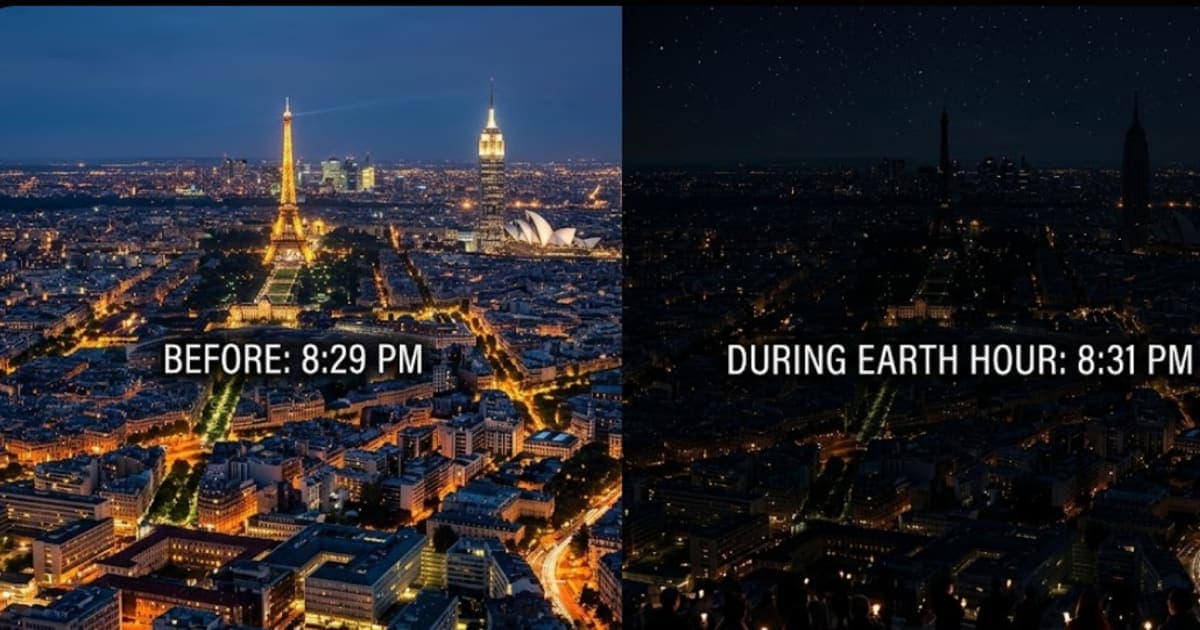
Once a year, for exactly sixty minutes, the Sydney Opera House goes dark.
So does the Eiffel Tower. The Empire State Building. The Forbidden City. And somewhere in the middle of all that, so does the living room of a family in Mumbai, a balcony in Nairobi, an apartment in Rio de Janeiro.
This is Earth Hour. It is the world's largest grassroots environmental initiative. And it works — not because of the electricity it saves, but because of the thing it makes visible.
The Problem With Invisible Problems
Climate change has a communication problem that no press release has fully solved.
The most devastating effects — rising sea levels, collapsing ice sheets, shifting weather systems — are gradual. They happen at scales that are difficult to hold in your mind at once. They are geographically concentrated in places that are far from where most decisions get made. And you cannot see a metric ton of CO₂. It is invisible, odorless, and everywhere.
This makes apathy the path of least resistance. Not malicious apathy — just the ordinary human tendency to stop engaging with things that don't have a face.
Earth Hour gives the problem a face. Or rather, it gives it a darkness.
When the Sydney Opera House goes dark simultaneously with the Eiffel Tower and the Empire State Building, the image doesn't require a caption or a statistics table to land. These structures exist to be illuminated. They project power, modernity, permanence in light — 24 hours a day, as a baseline condition of how the world works.
When they go dark together, the visual says something that a climate report cannot: we are stopping. Because we have to.
That's the gut punch. And it works.
Why Homes Matter More Than Landmarks
If only the famous buildings went dark, this would be a publicity stunt. Impressive, globally coordinated, but fundamentally a thing that institutions did while people watched.
The millions of households that participate are what change the nature of the event.
In most homes, Earth Hour isn't just about switching off lights. It tends to be a complete pause from the electronic hum of ordinary life. Dinner by candlelight. Neighbors gathering outside. Conversations that don't happen in the normal run of a Saturday evening.
And in that darkness, something specific occurs.
A person sitting in a dark living room in Chennai knows — actually knows — that they are synchronized in that exact moment with someone in Paris, someone in São Paulo, someone in Nairobi. That feeling of being part of something genuinely global is rare. Not global in the abstract sense of "the whole world is watching" — global in the concrete sense of my switch and ten million other switches, all flipped at the same time, for the same reason.
That feeling does something to the sense of individual helplessness that is, honestly, one of the biggest obstacles to climate action. My choice doesn't matter, the thinking goes, because I am one person and this is a planetary problem.
Earth Hour proves the logic wrong for one hour. And one hour, apparently, is enough to change something.
The Obvious Criticism, Taken Seriously
Let's address it directly: turning off your lights for sixty minutes saves a negligible amount of electricity. The math on kilowatt-hours doesn't add up to anything meaningful in the context of annual global emissions. Some critics point out that the surge in demand when everyone switches back on can briefly strain power grids, requiring more fossil fuel generation to manage the spike.
These criticisms are factually accurate. They are also beside the point.
Earth Hour was never designed to save the planet through direct energy reduction. It was designed to do something harder and more important: shift behavior.
The behavioral science here is well-documented. Making a small, low-cost commitment — one that requires no money, no specialized knowledge, almost no effort — increases the likelihood that a person will make larger, more difficult commitments later. It is called the foot-in-the-door effect. By participating in Earth Hour, a person quietly adds "environmentally conscious" to their own self-description.
And that self-description changes what they do next.
They're more likely to recycle. More likely to think about energy use in substantive ways. More likely to support pro-climate policies when given the choice. The switch is the gateway. Not the destination.
Why It Dominates the News Cycle
Earth Hour gives editors something that is genuinely rare in climate coverage: a beautiful story.
Climate journalism is hard to sustain in a competitive media environment because the dominant emotional register is dread. Loss. Urgency without clear resolution. These are important stories — they need to be told — but they are stories that audiences scroll past at a higher rate than stories that offer something else.
Earth Hour offers something else.
The before-and-after photographs of famous landmarks are high-contrast, visually striking, and designed — almost accidentally, almost inevitably — for social media sharing. They don't require explanation. They travel.
And the story they carry isn't only about what we're losing. It's about what 190 countries chose to do at the same time. That's a counter-narrative to the nationalist fragmentation and competitive geopolitics that dominate most international coverage. We argue about everything. Except, apparently, this.
What Happens After the Lights Come Back
Earth Hour started as a single event in Sydney in 2007. One city, one hour, a symbolic gesture that might or might not resonate.
It resonated.
WWF now uses the global attention generated by the hour to do the work that actually changes things: funding reforestation projects in Africa, advocacy for marine conservation in Latin America, pushing for plastic bans in Southeast Asia. The hour is the headline. The projects are the substance.
The lights coming back on after 60 minutes doesn't signal that the problem is solved or that the commitment was only symbolic. It signals that the symbolic commitment served its purpose — which was never to save the planet in sixty minutes, but to remind sixty minutes' worth of people that they care about the same thing and are capable of acting on it together.
That turns out to be harder to manufacture than you'd think. And worth manufacturing every time you can.
What One Switch Actually Means
When you flip the switch this March, you are not single-handedly reversing climate change. You know that. Everyone who participates knows that.
What you are doing is something smaller and, in a specific way, more powerful: you are choosing to be part of a moment where the visible proof of collective action exists, briefly, at a global scale.
The Eiffel Tower will go dark. The Opera House will go dark. Your living room will go dark.
And for sixty minutes, that synchronized darkness will be the clearest picture we have of how many of us are paying attention — and willing to do something about it, however small, however symbolic, however real.
Earth Hour 2026 takes place on the last Saturday of March. Organized by WWF, it has grown from a single Sydney event in 2007 to a global initiative spanning 190+ countries. For event timings and local participation details, visit wwf.org/earthhour.