The Roar No One Expected
Let’s be honest for a second. When the first teaser for Dhurandhar 2 dropped, my reaction was a weary sigh. Another sequel? Another gritty, slow-motion shot of Ranveer Singh looking brooding while something exploded behind him? I’d seen this movie before—or at least, a dozen variations of it. The critics seemed to agree, offering polite, tepid previews that predicted a modest, forgettable run. Competently made, they said. Formulaic, they whispered.
Well, the joke’s on us. The film didn’t just perform; it detonated. Crossing ₹200 crore at the domestic box office isn’t just a success; it’s a statement. And it’s a statement that has less to do with subverting formulas and everything to do with perfecting them with a kind of unapologetic, muscular joy. This isn’t a film that won in spite of being an action movie. It won because it is one, executed with a precision that feels almost radical in its straightforwardness.
The Alchemy of Star Power (When It Actually Works)
We throw around the term ‘chemistry’ until it loses all meaning, but watching Ranveer Singh and Arjun Rampal share the screen is a reminder of what the word actually signifies. It’s not just about liking each other; it’s about creating a dynamic where the space between them crackles with unspoken history and competing agendas.
Singh, for once, is reined in. His trademark cyclone of energy is channeled into a focused, physical intensity. His character isn’t a quippy superhero; he’s a man solving problems with his fists and a stubborn moral code, and the quieter moments—a glance of regret, a jaw tightening in resolve—land harder because of it. It’s his most mature action performance, proving he can speak volumes without shouting.
And then there’s Rampal. Good heavens, has anyone ever used silence and sheer physical presence more effectively? He doesn’t need a monologue. A raised eyebrow from Rampal carries more threat than a five-minute villainous rant. He’s the granite cliff to Singh’s wildfire, and their confrontations are less about who will win, and more about what each collision will cost their souls. The praise for their performances isn’t just critics being nice; it’s the undeniable core of the film’s appeal. We’re not watching CGI avatars fight. We’re watching men.
The Uncomplicated Joy of Things Going Boom
Here’s where the analysis gets simple, maybe even heretical: The action sequences are just fantastically well-made. In an era where fight scenes are often a blur of shaky-cam and quick cuts, Dhurandhar 2 commits the brave act of letting us actually see the action. The choreography is brutal and balletic. You feel the impact of every blow, the weight of every leap.
The much-talked-about highway truck sequence isn’t innovative because it’s never been done; it’s brilliant because of its clarity and escalating madness. You can follow the geography of the fight. The stakes are physical, immediate, and thrillingly absurd. The director, Kabir Malhotra, seems to understand a fundamental truth we’d forgotten: audiences love practical stunts. We love seeing real metal crumple and real bodies (or convincing facsimiles thereof) fly through the air. It taps into a childlike wonder that all the digital particle effects in the world can’t replicate.
The Audience Whisperer
So why did this particular film, out of all the action offerings this year, strike such a chord? I have a theory, and it’s only partly about the film itself.
We’re exhausted. The world is a complex, morally grey, and overwhelmingly stressful place. For three hours, Dhurandhar 2 offers a reprieve. It presents a world where good and evil are clearly defined, where a broken rib is the worst consequence of a bad day, and where the righteous hero can actually win through sheer grit and determination. It’s not escapism in the sense of fantasy; it’s escapism in the sense of simplicity.
The film doesn’t ask you to ponder geopolitical nuance or the trauma of violence. It asks you to cheer when the bad guy gets punched off a moving vehicle. And sometimes, that’s exactly the therapy we need. The box office numbers are a collective sigh of relief, a nationwide agreement to just enjoy the ride.
- It’s unpretentious. It knows what it is and makes zero apologies.
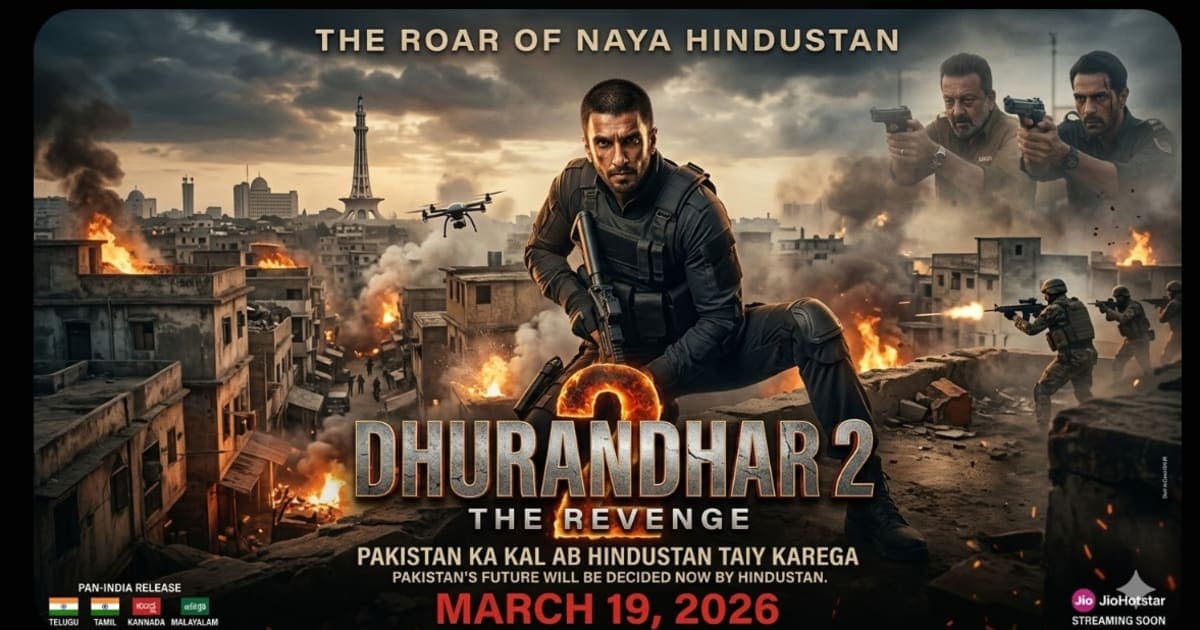
- It delivers on its promise. The poster promised epic clashes and larger-than-life heroes. The movie is nothing but epic clashes and larger-than-life heroes.
- It has a pulse. The score thumps, the editing propels you forward, and there’s a genuine sense of fun underpinning the violence.
A Footnote, or a New Chapter?
The inevitable question now is: what does this mean for Bollywood? Will we be drowning in a tsunami of Dhurandhar clones by next year?
I hope not. The lesson here isn’t “make more mindless action movies.” The lesson is “execute your genre with conviction and heart.” Audiences can smell cynicism. They can tell when a film is a calculated product. Dhurandhar 2 feels like it was made by people who genuinely love action movies, not by a committee trying to reverse-engineer a hit. Its success is a permission slip for filmmakers to embrace genre, to be excellent within a framework, rather than constantly trying to deconstruct it.
In the end, the film’s triumph is beautifully straightforward. It gave people a spectacularly good time. It reminded two brilliant actors of their raw, magnetic power. And it proved that in a crowded, noisy landscape, the clear, confident roar of a well-told story can still be heard above all the din. Now, if you’ll excuse me, I think I need to go watch that truck sequence one more time.