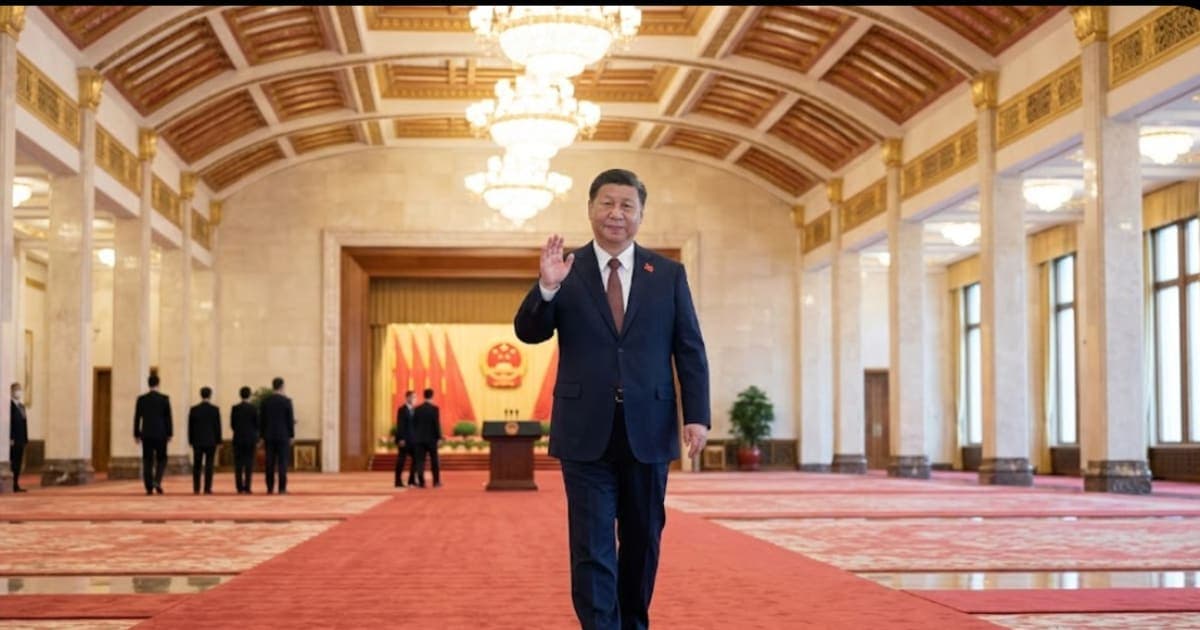
The "Great Cleaning": Xi Jinping Escalates Unprecedented Purge of China's Military Elite
In China, the political calendar is rarely accidental. The timing of announcements, the sequencing of removals, the choice of which names appear in state media and which simply vanish — all of it is deliberate. So when the Standing Committee of the Chinese People's Political Consultative Conference voted, without explanation, to strip three retired generals of their seats on the eve of the "Two Sessions" — the most watched political gathering in the Chinese calendar — it was not a coincidence.
It was a message.
The message, delivered in the characteristically opaque language of Beijing's disciplinary machinery, was this: retirement is not protection. Past loyalty is not a shield. And the purge that has already consumed China's active military high command is not finished.
Three Generals, No Explanation
The men removed are Han Weiguo, Liu Lei, and Gao Jin. Their names may not be familiar outside specialist circles, but within the PLA they represent something specific — the senior generation of officers who built and commanded China's military modernisation over the last decade.
Han Weiguo, 70, was commander of the PLA Ground Force from 2017 to 2021. His most visible public moment came in 2017, when he commanded the massive military parade at Zhurihe marking the PLA's 90th anniversary — standing directly alongside Xi Jinping on the reviewing platform. The photographs from that day, Han at Xi's shoulder, now read differently than they did then.
Liu Lei, also 70, served as the Ground Force's political commissar during Han's tenure. His removal alongside Han suggests a deliberate clean sweep of the former Ground Force leadership — not a targeted strike against one individual but an erasure of an entire command cohort.
Gao Jin, 67, was the inaugural commander of the Strategic Support Force — China's dedicated high-tech military branch for space operations, cyber warfare, and electronic intelligence. He later headed the CMC's Logistic Support Department before retiring in 2022. The SSF itself was dissolved earlier this year as part of the broader reorganisation, and Gao's removal closes a chapter on the force he built from the ground up.
The removal of retired officials from advisory bodies like the CPPCC is unusual enough to be significant in itself. These positions are largely ceremonial, but they carry status — they signal that a person remains within the system, still recognised, still respected. Stripping them publicly, without charges, without explanation, is the first step in a well-established process. Formal criminal investigation, when it comes, rarely surprises anyone who has been watching.
The Bigger Shock: Zhang Youxia
As significant as Monday's removals were, they are, in the broader context of 2026, a supporting act.
The headline development of this purge — the one that genuinely stopped analysts mid-sentence when it emerged in January — was the investigation of General Zhang Youxia, the senior Vice Chairman of the Central Military Commission. Zhang was not just a powerful figure in the PLA. He was widely understood to be Xi Jinping's closest military ally, a fellow princeling whose father served alongside Xi's father in the revolutionary era. If anyone in the Chinese military was considered untouchable, it was Zhang.
He is now under investigation.
Alongside him, General Liu Zhenli, Chief of the Joint Staff Department — the operational brain of the PLA — is also under scrutiny. In a matter of weeks, the two most operationally significant figures in China's military command structure have effectively been removed from the picture.
"Xi has completed the most significant purge of military leadership in the history of the People's Republic," one regional security analyst told this correspondent. "By moving against Zhang Youxia, he has sent a message: loyalty is not a shield, and no one is untouchable."
An Empty Table at the Top
What makes this purge qualitatively different from previous waves is what it has left behind — or more precisely, what it has left absent.
The Central Military Commission, China's supreme military authority, is historically a body of seven. As of March 2026, it functions with two.
| Position | Status |
|---|---|
| Chairman | Xi Jinping — Active |
| Vice Chairman | Zhang Youxia — Under Investigation |
| Vice Chairman | He Weidong — Expelled, October 2025 |
| Defence Minister | Li Shangfu — Expelled/Ousted |
| Joint Staff Chief | Liu Zhenli — Under Investigation |
| Political Work Dir. | Miao Hua — Expelled, December 2025 |
| Discipline Secretary | Zhang Shengmin — Active |
Xi Jinping and his top anti-corruption officer. That is what remains of China's military high command.
Below the CMC, the picture is similarly hollowed out. The Rocket Force — China's nuclear and conventional missile arm — has been in leadership turmoil for over a year. Key theatre commanders have been rotated mid-term. The institutional continuity that professional militaries depend on — shared doctrine, accumulated trust between commanders, the unspoken knowledge of how the person next to you makes decisions under pressure — is being systematically disrupted.
The PLA is, on paper, the largest military force on earth. What it looks like in practice, right now, is a different question.
Beyond Corruption: The Shift to "Political Rectification"
For years, Xi's military purges were framed around a coherent and internally logical narrative: corruption. Generals taking bribes for promotions. Defence contractors buying influence. Procurement officials skimming from weapons contracts. The "tigers and flies" campaign gave the purges a rationale that was, if not entirely credible, at least comprehensible.
That framing has quietly shifted in 2026.
The language coming from Xi's office and from CMC directives now emphasises "self-revolution" and "political rectification." These are not anti-corruption terms. They are ideological terms — and the distinction is important.
Sources familiar with internal PLA discussions suggest that what is now being treated as disqualifying is not financial corruption but political doubt. Senior generals who reportedly expressed private reservations about the feasibility of a Taiwan military operation by 2027. Officers who raised technical concerns about the reliability of elements of the Rocket Force's nuclear arsenal. In Xi's current framework, a general who quietly questions the timeline is apparently as dangerous as a general who takes a bribe — perhaps more so, because doubt is harder to detect and harder to contain.
The PLA is being asked not merely to be capable. It is being asked to be believing.
Taiwan, the Middle East, and What This Means
The obvious question, given the simultaneous eruption of the US-Israel-Iran conflict in the Gulf, is whether China might see an opportunity in American distraction. The instinct to ask the question is understandable. The answer, for now at least, is probably not.
A military in the middle of its most significant leadership purge in modern history is not a military in optimal condition for a high-risk, high-complexity amphibious invasion. Three specific dynamics work against it:
Disrupted command. New commanders need time — not weeks, but months and years — to build the relationships and mutual understanding that joint operations require. The PLA's joint command structure has been turned over repeatedly. That is not an advantage in a Taiwan contingency.
The paralysis of fear. When mid-level officers watch their superiors disappear into anti-corruption investigations, the rational response is extreme caution. Initiative collapses. Officers stop making decisions that could be retrospectively reframed as errors of political judgement. Militaries that have undergone intense political purges historically underperform for years afterward — Stalin's Red Army in 1941 being the most instructive example.
Inward focus. Right now, the most intense institutional energy in the PLA is directed at internal discipline, not external operations. The Discipline Inspection Commission is, for this moment, the most powerful body in the Chinese military.
None of this means Taiwan is safe indefinitely. It means the clock is being reset, not stopped.
What Xi Is Actually Building
Step back from the individual removals and a coherent strategy emerges — one that is rational on its own terms, even if deeply destabilising in its execution.
Xi has set 2027, the PLA's centennial, as his hard deadline for military modernisation — a force that is "mechanised, networked, and intelligent." The generals being purged now are, almost uniformly, products of an older era: officers who came up through the pre-Xi system, who built their careers under different patrons, who carry institutional loyalties that predate his tenure.
What Xi appears to be clearing space for is a younger generation of technocratic officers — people whose entire careers have unfolded under his watch, who have no institutional memory of a PLA that operated differently, and whose advancement is entirely dependent on his favour. A military that is not merely obedient but structurally incapable of being otherwise.
Whether that produces a more capable and professional force, or whether it produces what military historians sometimes call a "paper tiger" — an organisation that looks formidable on paper but is paralysed by internal fear and sycophancy — is the question that defence analysts in Washington, Tokyo, and Taipei are spending considerable time trying to answer.
The Empty Seats in Beijing
Tomorrow, the delegates gather in the Great Hall of the People for the Two Sessions. The military delegation will be there — uniformed, decorated, arranged in the precise formation that Chinese political theatre requires. From a distance, it will look like it always has.
Look more carefully at the seats, and at the faces that are not in them, and a different picture emerges. The PLA that assembles this week is one in which the top operational command has been gutted, the institutional leadership is in legal jeopardy, and the officers who remain are acutely aware that their predecessors' careers ended in interrogation rooms.
Xi Jinping is remaking the Chinese military in his own image — loyal to him personally, ideologically aligned, and stripped of any independent institutional power base. He may well succeed. The question is what kind of military emerges from the process, and whether it will be ready when, eventually, he decides to use it.
All information reflects assessments available at time of publication. The situation regarding PLA personnel is subject to rapid change.