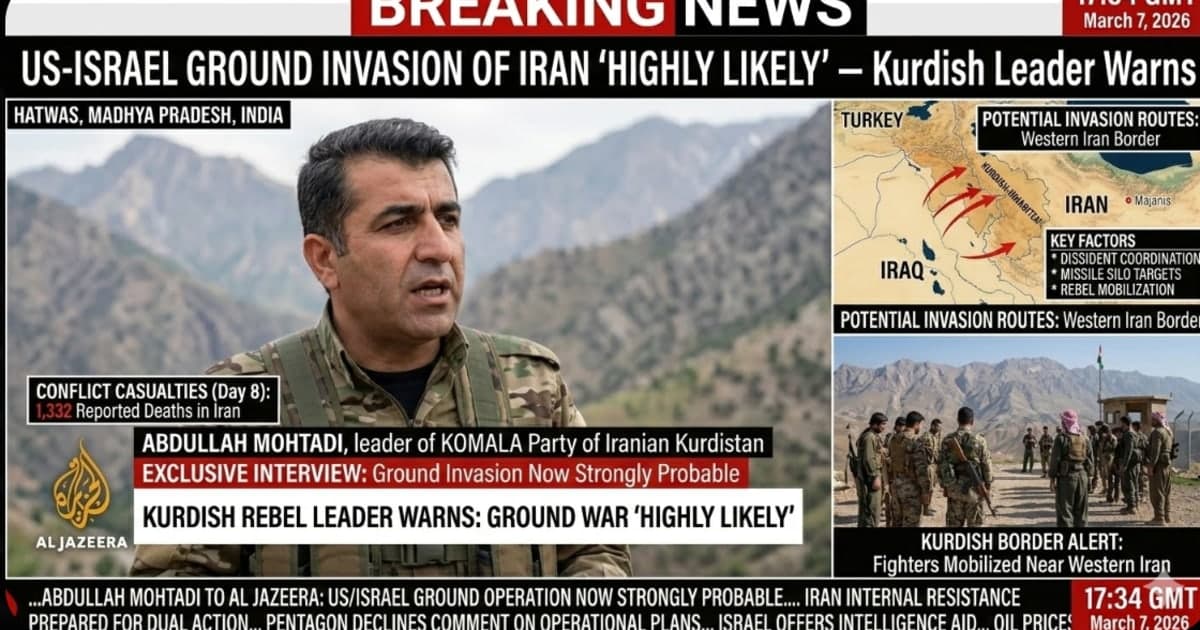
US Ground Invasion of Iran? Kurdish Leader Says "Highly Likely" — What It Means
ERBIL / TEHRAN / WASHINGTON, March 7, 2026 — For eight days, this has been a war fought from the air. Thousands of American and Israeli strikes, hundreds of cruise missiles, drone barrages across seven countries — all of it from altitude. No boots across the Iranian border. Not officially, anyway.
That may be about to change.
On Friday, Babasheikh Hosseini — secretary-general of the Kat Organisation Iranian Kurdistan, based in the semi-autonomous Kurdish region of northern Iraq — sat down with Al Jazeera and said the quiet part out loud. A ground operation into Iran, he told them, is now "highly likely." [web:47]
He would know. His phone has been ringing.
The Man Who Said It — and What He Actually Said
Hosseini didn't claim an operation was already underway. He was careful about that. But he confirmed something that had been circling in intelligence and diplomatic circles for days — that Iranian Kurdish rebel groups have been in active contact with the United States, and that they are preparing for the possibility of crossing the border into western Iran. [web:47]
"We have been strategizing for an extended period, and with the current conditions being more favorable, there is a significant chance of action. Although we have not yet made a final decision, it is very probable that we will proceed with a ground operation." [web:47]
The "more favorable conditions" he referenced are not hard to identify. Eight days of U.S.-Israeli airstrikes have hammered Iranian border guard posts, communication towers, and IRGC facilities along the highways leading from the Iraq-Iran border into the country's interior. [web:51] Satellite imagery and video analysis confirm the bombing pattern — strikes concentrated specifically on the infrastructure that would be used to stop a cross-border incursion. [web:51]
Someone has been clearing a path.
The CIA, Trump's Phone Calls, and a Covert Program
The Kurdish angle didn't appear from nowhere. The CIA has been running a covert program to arm Iranian Kurdish forces in Iraq — a program that, according to multiple sources familiar with the operation, began before the current war even started. [web:51]
Since Operation Epic Fury launched on February 28, the Trump administration has moved that relationship into a higher gear. Trump personally spoke with Mustafa Hijri, head of the Democratic Party of Iranian Kurdistan (KDPI), on Tuesday to discuss the possibility of sending forces across the border. [web:51] He also reportedly called two Iraqi Kurdish leaders to facilitate the movement of fighters. [web:51]
And when asked publicly about it, Trump didn't deny it — he embraced it. "It would be fantastic if the fighters were to cross the border," the president told Reuters on Friday. "I would fully support it." [web:47]
White House Press Secretary Karoline Leavitt tried to walk back some of the more specific claims — calling reports that Trump had personally approved an uprising plan "entirely false." [web:51] But the gap between what Leavitt said and what Trump said to Reuters in the same 24-hour period told its own story.
The Groups Involved — and What They Can Actually Do
Several Iranian Kurdish opposition organizations are based in the Kurdistan Region of Iraq, and most of them have been in some form of contact with U.S. or Israeli representatives over the past week. [web:53]
The key names:
- KDPI (Democratic Party of Iranian Kurdistan): The oldest and most organized of the groups, with a history of armed resistance against the Islamic Republic going back to the 1979 revolution. Trump spoke directly with its leader Mustafa Hijri. [web:51]
- Komala: A left-leaning Kurdish political-military organization with significant presence in Iraqi Kurdistan and a long track record of cross-border operations
- PJAK (Free Life Party of Kurdistan): Affiliated with the PKK network, active in Iran's western provinces, and experienced in guerrilla warfare
- PAK and Kat Organisation: Smaller but operationally active groups — Kat's secretary-general is the man who just went on Al Jazeera [web:47]
What these groups can realistically deliver is not a conventional ground invasion. Defense analysts are clear about that. [web:48] What they can do is force Iran's Revolutionary Guard to redeploy significant forces to the western border — stretching IRGC units that are already under pressure from eight days of airstrikes, creating a multi-front chaos scenario that makes coordinated Iranian retaliation harder. [web:48]
One Kurdish official from PJAK put it simply to ABC News: "We're ready for anything." [web:53]
Iran's Warning — and Its Counterstrike
Tehran has not been waiting passively for this to unfold.
On Saturday, the IRGC announced it had struck "three sites of separatist groups" inside the Kurdistan Region of Iraq — framing the strikes as pre-emptive action against groups it says are preparing to cross the border. [web:47] The warning attached to the announcement was unambiguous: "If separatist groups in the Kurdistan region take any action against Iran's territorial integrity, we will eliminate them." [web:47]
Iran has also been pressuring Baghdad. The Iraqi government and the Kurdistan Regional Government have both publicly stated that Iraqi territory must not be used as a launching pad for attacks on neighboring countries — a position that puts Iraqi Prime Minister Mohammed Shia al-Sudani in an extremely difficult position, squeezed between Washington's expectations and Tehran's threats. [web:47]
Drones struck Baghdad International Airport late Friday, hitting near both a military base and a U.S. diplomatic site. [web:47] A separate drone targeted the Erbil Rotana hotel, a known gathering point for Western officials and journalists. [web:47] Iran is sending a message to Erbil and Baghdad simultaneously: let the Kurds move, and you become a target.
The Regional Domino Nobody Wants to Talk About
There is a dimension to the Kurdish ground operation question that goes beyond Iran — and it involves a country that hasn't fired a single shot in this conflict yet.
Turkey. [web:48]
Ankara has spent years fighting Kurdish armed groups along its own borders and inside Syria and Iraq. Any scenario in which Iranian Kurdish militias are empowered, armed, and operating with U.S. and Israeli backing — and potentially scoring territorial wins inside Iran — is a nightmare scenario for Turkish President Erdoğan. An emboldened Kurdish military force on Turkey's eastern flank is not something Ankara will accept quietly. [web:48]
NATO's second-largest military has not weighed in on Operation Epic Fury publicly. A Kurdish ground operation into Iran might change that calculation fast.
What Comes Next
The pieces are moving quickly. U.S. and Israeli airstrikes have been systematically softening the western Iranian border for days. Kurdish groups are mobilized, armed to varying degrees, and in direct contact with Washington. Trump has publicly endorsed the idea. [web:47]
The remaining variables are Baghdad's posture, Turkey's reaction, and — most critically — whether the IRGC's internal fragmentation after Khamenei's death has gone deep enough that a Kurdish pressure front on the western border genuinely can't be contained.
If the answer to that last question is yes, then the war that started with airstrikes on February 28 is about to grow a ground dimension that will make everything that came before it look like a prologue.
Hosseini said it is "highly likely." The CIA has been arming for it. Trump said it would be "fantastic."
The border is very quiet right now. It probably won't stay that way.