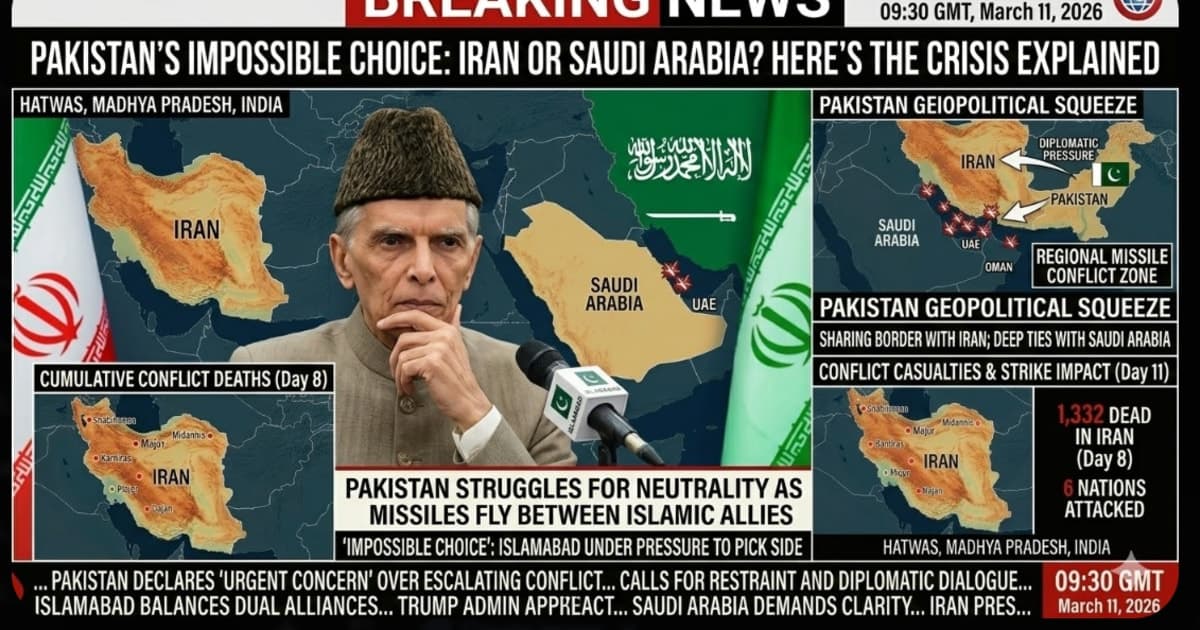
Pakistan's Impossible Choice: Iran or Saudi Arabia? Here's the Crisis Explained
ISLAMABAD / RIYADH / TEHRAN, March 7, 2026 — Pakistan has spent eight days doing something extraordinarily difficult — trying to be everyone's friend while missiles fly over everyone's heads.
It isn't working as cleanly as Islamabad hoped.
A nuclear-armed country of 240 million people, Pakistan shares a long border with Iran, hosts millions of Shia Muslims who feel a cultural and religious pull toward Tehran, and simultaneously holds a brand-new NATO-style defense pact with Saudi Arabia that says — in plain language — an attack on one is an attack on both. [web:63] Iran has been bombing Saudi Arabia for eight straight days. The pact, signed just last September, has never been tested under conditions remotely like these.
The testing has now begun.
The Pact That's Forcing the Choice
In September 2025, Pakistan and Saudi Arabia formalized what they called a Strategic Mutual Defence Agreement — the SMDA. The language is as close to a mutual defense treaty as any two Islamic nations have signed in recent memory. [web:63] Aggression against one party is treated as aggression against both. It establishes frameworks for collective deterrence, intelligence sharing, and coordinated defensive responses. [web:64]
When Iran started firing drones and missiles at Saudi oil infrastructure and military bases, that pact didn't stay theoretical for very long.
Pakistan's Foreign Minister Ishaq Dar was already in Riyadh for an Organisation of Islamic Cooperation meeting when the war broke out on February 28. Within hours, he was on the phone to Tehran — not to condemn the strikes, but to invoke the pact. Explicitly. By name. [web:62]
"We have a defense pact with Saudi Arabia, and the entire world is aware of it," Dar told Iranian Foreign Minister Abbas Araghchi directly. [web:58]
It was the first time any Pakistani official had said out loud that the SMDA applied to the Iran war. And according to Dar himself, it worked — Tehran asked for assurances that Saudi soil wouldn't be used to launch attacks on Iran, Pakistan relayed those assurances from Riyadh, and Saudi Arabia absorbed fewer strikes than any other Gulf state in the opening days. [web:62]
"Unlike all other countries, Saudi Arabia faced the least attacks," Dar noted pointedly. [web:62]
Pakistan's nuclear shadow, quietly stretched over Riyadh, appears to have given Iran pause.
The Shuttle Diplomat Nobody Expected
While the world was watching explosions, Ishaq Dar was on planes.
He described his own role with unusual candor — "shuttle diplomacy" between Tehran and Riyadh, carrying messages back and forth between two capitals that aren't speaking to each other directly. [web:58] On March 3, he told Pakistan's Senate what he'd been doing: mediating, warning, and threading the needle between a defense commitment to Saudi Arabia and a border relationship with Iran that Pakistan cannot afford to destroy. [web:59]
Islamabad condemned the original U.S.-Israeli strikes as "unjustified" on February 28. [web:58] Days later, it criticized Iran's retaliatory strikes on Gulf nations as "clear violations of sovereignty." [web:58] That double condemnation — criticizing both sides — is the Pakistani diplomatic formula. It buys goodwill on both sides of the conflict. It also satisfies nobody completely, and the clock on how long it works is running out.
Two Pakistans in One Country
What makes Pakistan's position genuinely unique — and genuinely precarious — is that the tension isn't just external. It lives inside Pakistan's own borders.
The country has a substantial Shia Muslim population, and Iran has deep religious and cultural roots in Pakistani society. In Islamabad, Karachi, and Lahore, protesters have taken to the streets in support of Iran. [web:61] "If the government sides with Saudi Arabia against Iran, it will create deep resentment within the country," one protester in Islamabad told Middle East Eye. [web:61]
Senior Pakistani officials hear those voices. "We understand the sentiments on the street," one security official said, speaking anonymously. "But the state must act according to long-term national interests." [web:61]
Those long-term national interests are complicated. Saudi Arabia is where approximately 2.5 million Pakistani workers are employed, sending remittances home that keep millions of families afloat. Riyadh has historically bailed Islamabad out during financial crises, and the SMDA came with substantial economic sweeteners. [web:66]
Iran, on the other hand, shares an 800-kilometer border with Pakistan — a border that has never been fully secured, that has seen cross-border militant activity in both directions, and that Pakistan cannot afford to see turn hostile. In January 2024, Iran and Pakistan actually exchanged missile strikes over alleged militant sanctuaries. [web:58] The relationship is volatile, but it is also unavoidable.
"Pakistan has vital national interests in ensuring Iran's stability and territorial integrity," Ilhan Niaz, a history professor at Quaid-e-Azam University, told Al Jazeera. "The disintegration of Iran into civil conflict — its fragmentation into warring factions — and Israeli reach to Pakistan's western borders are all developments that deeply concern Islamabad." [web:58]
The Question Nobody in Islamabad Wants to Answer
Could Pakistan actually be pulled into active military participation in this war?
Defense analysts are split — but the consensus leans toward "no, for now." [web:66] Direct military action against Iran is essentially off the table given domestic political constraints, the border reality, and the sectarian mathematics of Pakistani society. [web:58]
What is not off the table — and what analysts say Saudi Arabia may eventually request — is the deployment of Pakistani air defense systems to protect Saudi territory from Iranian drone and missile attacks. [web:58] Pakistan has advanced air defense capabilities. Deploying them to Saudi Arabia would mean joining the war in everything but name.
"As the situation escalates and Saudi energy facilities are targeted, it is only a matter of time before Saudi Arabia requests Pakistan's assistance in its defense," warned Umar Karim of the King Faisal Center for Research and Islamic Studies in Riyadh. "If Pakistan deploys air defense assets to Saudi Arabia, it could leave its own air defenses vulnerable — and deeper involvement could carry severe political ramifications domestically." [web:58]
Army Chief General Asim Munir held a formal call with Saudi Defense Minister Khalid bin Salman this week. The Pakistani military's Inter-Services Public Relations office described the call as routine. Analysts who read the statement carefully noted that the word "routine" was doing an enormous amount of work. [web:59]
The Worst-Case Scenario for Islamabad
Pakistan's strategic community has identified the scenario it fears most — and it has nothing to do with Iranian missiles. [web:58]
The nightmare is a Gulf Cooperation Council collective decision to formally enter the war. Saudi Arabia and the UAE have already declared that Iranian attacks have "crossed a red line." A joint GCC statement from Bahrain, Jordan, Qatar, Saudi Arabia, and the UAE has formally affirmed their "right to self-defense." [web:58]
If the GCC mobilizes collectively, Pakistan's SMDA with Saudi Arabia stops being an abstract deterrent and starts being a military obligation with a very specific ask attached to it. [web:63]
Islamabad has been a mediator for eight days. It has been the quiet phone call between Tehran and Riyadh. It has been the nuclear shadow that made Iran count the cost before hitting Saudi Arabia too hard.
But mediation only works while both sides still want something from the mediator. If Saudi Arabia stops wanting diplomacy and starts wanting air defense batteries on its northern border, Pakistan's impossible balancing act ends — and a very difficult choice begins.
"If Tehran forces Pakistan to choose between Iran and Saudi Arabia, the choice would undoubtedly favor the Saudis," Niaz said flatly. [web:58]
Nobody in Islamabad wants it to come to that. The question is whether anyone in Tehran or Riyadh is paying attention to what Islamabad wants.