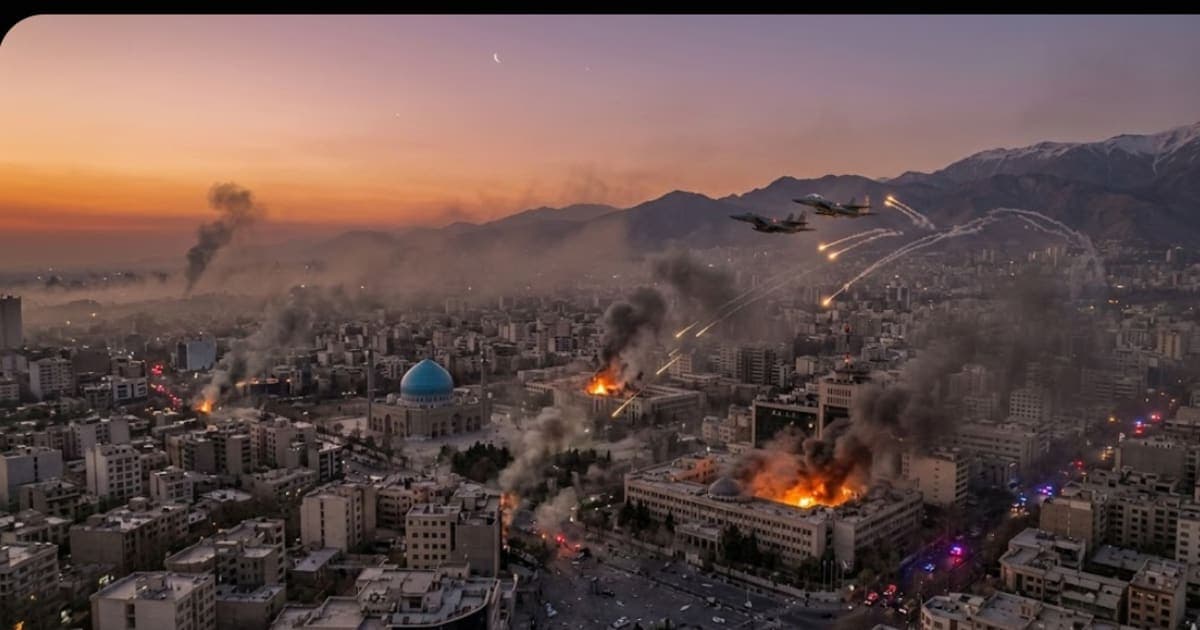
Operation Epic Fury: America and Israel Strike Iran — The World Holds Its Breath
Nobody really believed it would happen. For years, the threats were rhetorical, the red lines were redrawn, and the diplomats kept talking. Then, on the morning of February 28, 2026, it did happen — and the Middle East that existed before that morning no longer exists.
The United States and Israel launched a coordinated military campaign of a scale not seen in the region since the 2003 invasion of Iraq. But this was something different. This wasn't a ground invasion. This was, from the opening hour, an attempt to cut the head off the Islamic Republic of Iran entirely.
It largely worked. And that is precisely what makes the next few weeks so dangerous.
The Strike That Changed Everything
The compound on Pasteur Street in Tehran had always been one of the most fortified addresses on earth. Guards, concrete, surveillance, air defence systems layered on top of each other over decades. None of it mattered.
On the morning of February 28, a combination of American Tomahawk cruise missiles and Israeli stealth aircraft hit the Supreme Leader's compound and the Presidential Palace in a precisely sequenced strike. Iranian state media denied it, then went quiet, then confirmed what the world had already suspected: Ayatollah Ali Khamenei, 86 years old and the central governing authority of the Islamic Republic for over three decades, was dead.
Killed alongside him were Ali Shamkhani, former head of the Supreme National Security Council; Mohammad Pakpour, Commander-in-Chief of the IRGC Ground Forces; and several members of Khamenei's immediate family. It was not a warning shot. It was a decapitation.
Senior official Ali Larijani now heads an interim leadership council navigating a regime in freefall, attempting to project defiance while managing the actual collapse of its command structure.
What Washington Said It Wanted
President Trump addressed the nation from the White House within hours of the strikes beginning. He was direct in a way that left no room for diplomatic interpretation.
The operation, he said, was a "last best chance" to eliminate what his administration has described for months as an existential nuclear threat. The stated objectives were sweeping:
- Dismantling the nuclear programme — enrichment facilities, research sites, the full infrastructure of Iran's atomic ambitions
- Destroying missile and drone capabilities — ballistic silos, manufacturing plants, launch infrastructure
- Clearing the Persian Gulf — the Iranian Navy, he made clear, was a target
- Regime change — not implied, not hinted at. Stated outright.
"We projected four to five weeks," Trump said, "but we have the capability to go far longer than that."
That last sentence is the one that should concern everyone — not because it signals weakness, but because it signals comfort with an open-ended campaign. History has a long record of what happens when military operations are framed that way.
The Human Cost, Four Days In
Wars are not just geopolitical abstractions. By March 3, the cost in human terms was already significant and climbing.
| Category | Figures (as of March 3, 2026) |
|---|---|
| U.S. Casualties | 6 killed, 18+ seriously wounded |
| Israeli Casualties | 12 killed, including 9 in a single missile strike on Beit Shemesh |
| Iranian Military | 1,000–1,500 personnel killed; 11 warships sunk |
| Iranian Civilian Toll | 787+ killed (per Iranian Red Crescent) |
The three American soldiers killed in Kuwait died in a retaliatory strike on a U.S. base — a reminder that even an operation proceeding "ahead of timeline," as Pentagon briefers described it, extracts a cost that doesn't show up in the strategic objectives slide.
The 787 Iranian civilian deaths is the number the Iranian Red Crescent is willing to report publicly. The actual figure is almost certainly higher.
Iran Hits Back — Broadly
The Islamic Republic did not go quietly. Within hours of the initial strikes, the IRGC began launching retaliatory waves of ballistic missiles and kamikaze drones across the region in a pattern clearly designed to stretch U.S. and allied air defences simultaneously.
Targets included:
- Al-Udeid Air Base in Qatar — the largest American military installation in the Middle East
- Bahrain and Kuwait — both hosting significant U.S. force concentrations
- The UAE and Saudi Arabia — intercepts were triggered over Dubai and Riyadh, forcing the evacuation of non-essential U.S. personnel from six countries in the region
Most significantly, Iran declared the Strait of Hormuz closed to shipping. That single announcement sent oil markets into a spiral. Roughly 20 percent of the world's petroleum passes through that narrow waterway. Shipping companies began rerouting vessels immediately. The price spike was instant. The economic consequences of a prolonged closure would be anything but.
What Happens Now
The honest answer is that nobody knows — including, one suspects, the people who ordered the strikes.
The U.S. and Israel hold air supremacy. That is not in dispute. But the IRGC is fighting from hardened underground facilities, its command structure is decentralised enough to absorb the loss of top leadership, and its operatives across Lebanon, Yemen, Iraq, and Syria have not been neutralised. The Islamic Republic is wounded. It is not yet finished.
The international picture is fractured in predictable ways. Some Gulf Arab governments have quietly welcomed the degradation of Iranian power — they have been asking Washington to do something about Tehran for years. Others are watching the regional order dissolve in real time and wondering what comes after the regime. Chaos in Iran does not automatically mean stability for its neighbours.
Inside Washington, a small but vocal group of lawmakers is pushing a War Powers Resolution to force Congressional authorisation for what is, by any measure, a war — regardless of what the administration chooses to call it in its press briefings.
The Question Nobody Wants to Answer
There is a version of this where it works. The nuclear programme is set back by years, the missile infrastructure is crippled, the regime either collapses or negotiates from a position of genuine weakness, and the region recalibrates around a diminished Iran. That version exists.
There is another version — historically the more common one — where a decapitation strike removes the leadership that could have negotiated a ceasefire, replaces it with hardliners who have nothing left to lose, and produces not a surgical campaign but a multi-year regional war with no clean exit.
Four days in, with the Supreme Leader dead, the Strait of Hormuz closed, oil prices rising, and American soldiers coming home in caskets, the world is waiting to find out which version this is.
The next 48 hours will tell us more than the last four days have. They usually do.