"To Be Free, We Must Be Feared": Macron Unveils Historic Expansion of France's Nuclear Arsenal
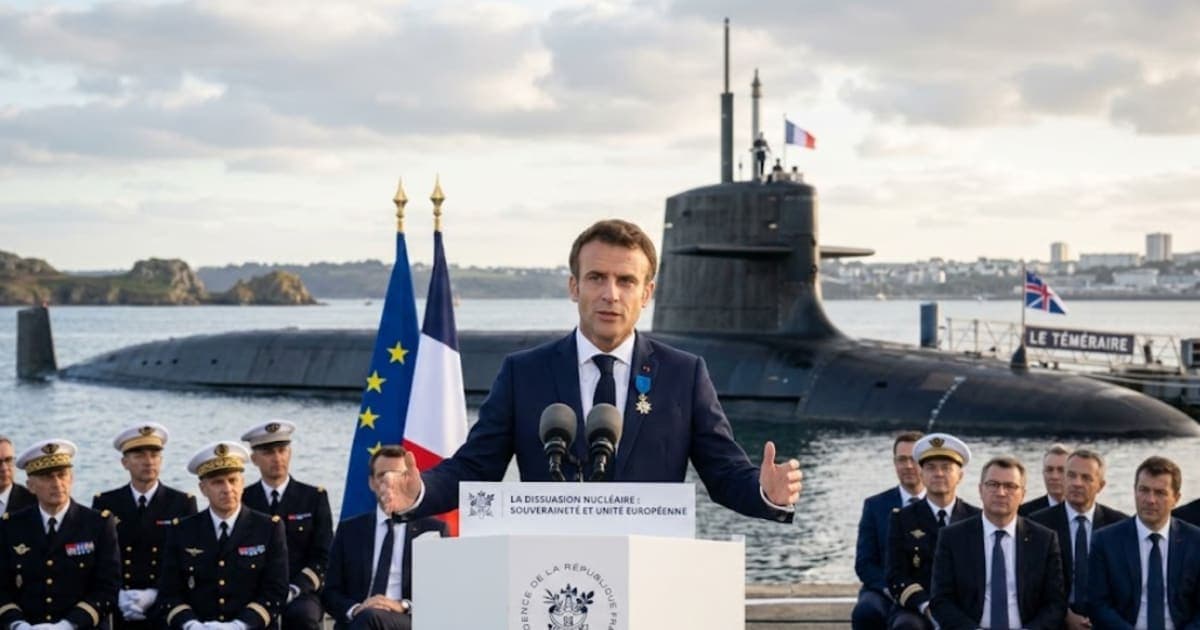
There is a reason Emmanuel Macron chose Île Longue for this speech.
The naval base on the Breton coast is not a stage — it is a statement. It is where France's nuclear-armed submarines slip quietly into the Atlantic, where the most consequential weapons in the European arsenal are housed, maintained, and kept perpetually ready. Standing there, with the dark silhouette of a nuclear submarine framing the shot behind him, Macron didn't need to say much before the symbolism had already done the work.
But he said a great deal anyway. And what he said will be studied in foreign ministries and defence ministries for years.
For the first time since the Cold War ended, France is expanding its nuclear stockpile. Not maintaining it. Not modernising it. Expanding it — and extending a nuclear umbrella over eight European allies who have spent decades sheltering under Washington's instead.
Thirty Years of Restraint, Ended in a Single Speech
Since roughly 1992, France has operated its nuclear arsenal under a doctrine of strict sufficiency — a philosophical and strategic commitment to maintaining only as many warheads as necessary to deter a potential adversary, not a single one more. For over three decades, that translated to approximately 290 warheads, a number that made France the fourth-largest nuclear power in the world but one that reflected deliberate, principled restraint.
That era is now officially over.
Macron announced several concrete shifts in French nuclear posture, the most significant of which is the simplest: France is building more warheads. He declined to give a target number, but framed the expansion in terms of preserving "assured destructive power" against the increasingly sophisticated missile defence systems that potential adversaries have developed since the Cold War calculus was last run.
The other changes compound the significance of the first:
Strategic ambiguity replaces transparency. France will no longer publicly disclose the size of its nuclear stockpile. Where previously a degree of openness served a deterrence function — reassuring allies and cautioning adversaries — Paris has now concluded that uncertainty itself is a more powerful tool.
Hypersonic missiles are being accelerated. New maneuverable hypersonic weapons capable of defeating modern air defence systems will be integrated onto both submarines and the next generation of French aircraft carriers. The technical message is pointed: whatever defences you build, France intends to be able to get through them.
Eight Nations Under the French Umbrella
The expansion of France's own arsenal was, in some ways, the less surprising half of the announcement. What startled European capitals — and alarmed disarmament advocates — was the second part: the "Advance Deterrence" framework.
Under this new doctrine, France is extending its nuclear guarantee to eight specific European partners:
- United Kingdom
- Germany
- Poland
- The Netherlands
- Belgium
- Greece
- Sweden
- Denmark
In practical terms, this means nuclear-capable French Rafale fighter jets will be forward-deployed to allied territory during periods of heightened tension. It means joint nuclear wargames, the integration of allied conventional forces into French nuclear planning, and a shared strategic architecture that Europe has not had since NATO's Cold War peak.
What it does not mean — and Macron was emphatic on this point — is any dilution of French sovereign command. The decision to use nuclear weapons remains, and will always remain, solely with the President of France. This is not a collective deterrent in the NATO sense. It is France offering a guarantee, on its own terms, with its finger on its own trigger.
The distinction matters. But so does the offer itself. For countries like Poland and Sweden, which have watched Russia's behaviour in Ukraine with mounting anxiety and American commitment with mounting uncertainty, the French umbrella is not nothing. It is, in fact, quite a lot.
Why Now? The Honest Answer
Macron framed his decision in carefully chosen language — "geopolitical rupture," "a world of escalating disorder." These are real things. But it's worth being direct about the specific triggers, because they are more particular than the rhetoric suggests.
The war in the Middle East demonstrated, in real time, the capacity for a regional conflict to escalate beyond anyone's initial projections. The US-Israeli military campaign in Iran has become exactly the kind of open-ended operation that European leaders feared — one that consumes American attention, absorbs American assets, and implicitly asks European allies to manage their own security in the meantime.
The Trump administration's posture toward Europe has been consistent and unambiguous: the era of the United States subsidising European defence is over. "America First" is not a slogan in Washington right now; it is policy. For Macron, who has been arguing for European strategic autonomy for years and largely been ignored, the argument has now made itself.
Russia and China need little elaboration. A nuclear-armed Russia actively at war on European soil, and a China conducting the most significant military expansion in its history, together constitute a threat environment that Europe's post-Cold War defence posture was simply not designed to handle.
Macron put it plainly enough in the speech: "Our destiny as Europeans can no longer be outsourced; it must be seized."
How Europe Reacted
The response from allied governments was broadly supportive, though the enthusiasm was not uniform.
German Chancellor Friedrich Merz, in a joint statement with Macron, announced the creation of a high-level nuclear steering group — a structural acknowledgement that Berlin is prepared to engage seriously with French nuclear planning for the first time in the Federal Republic's history. Given Germany's particular historical sensitivity around nuclear weapons and its post-war identity as a non-nuclear state, this is a significant step.
Polish Prime Minister Donald Tusk was less measured and more direct, posting on social media that "we are arming up together with our friends so that our enemies will never dare to attack us." For Warsaw, which has been begging NATO and the United States for deeper security commitments for years, the French umbrella is welcome news.
The criticism came quickly too. The International Campaign to Abolish Nuclear Weapons warned that Macron's "to be feared" doctrine risked triggering precisely the kind of European arms race that generations of diplomats worked to prevent. Some disarmament-oriented opposition figures within France itself raised questions about democratic accountability for a decision of this magnitude made without a parliamentary vote.
And hovering over all of it, unaddressed in the speech but clearly present in every analysis: how does Russia respond? Moscow has already signalled deep unease about French nuclear doctrine. An expanded stockpile, eight new umbrella allies, and Rafales deployed to Poland and the Baltic approaches is not going to be received quietly in the Kremlin.
The Speech Behind the Speech
Read it again, slowly: "To be free, we must be feared."
It is a striking formulation — deliberately so. Macron is a politician who chooses his words with considerable care, and he chose this one in front of the cameras, in front of the submarines, in front of the world. The phrase is partly Gaullist — it echoes the deep French tradition of sovereign independence and military grandeur that runs from de Gaulle through every president who followed. But it is also a break from the language of post-Cold War liberal internationalism, which tended to frame security in terms of cooperation, norms, and mutual assurance.
This was not the language of mutual assurance. This was a declaration that the era of hoping others will protect you is over — and that the alternative is power, specifically French power, specifically nuclear power.
Whether that turns out to be the right bet for Europe depends entirely on what happens next: in Ukraine, in the Gulf, in Washington, and in whatever calculation Vladimir Putin makes when he looks at a map of a continent that has just decided to rearm.
What is not in doubt is that March 2, 2026 was the day Europe changed its mind about nuclear weapons. After thirty years of treating them as a Cold War relic, it has decided they are the future.
This article reflects information available at time of publication. Statements from allied governments and international bodies may have been updated following the speech.