Beirut Is Burning Again. And This Time, the Whole Country Is Running.
The people who had come back to check on their apartments in Dahiyeh — to see what was left, to salvage something — were running again by midmorning.
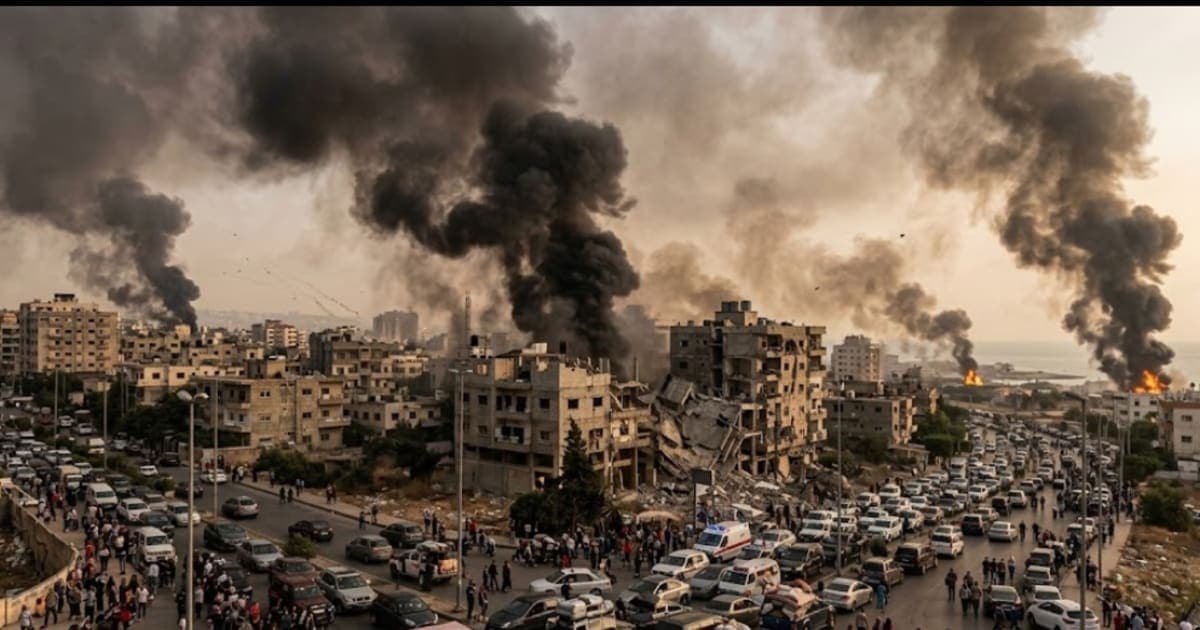
The explosions returned without much warning, the way they always do. Black smoke climbed above the southern suburbs. Emergency services pushed toward buildings that were no longer standing. And on the highways out of Beirut, the traffic stopped moving entirely.
Israel resumed intensive airstrikes on the Lebanese capital today, concentrating on the Dahiyeh district in a bombardment that witnesses described as heavier and more sustained than anything in recent weeks. Hezbollah had launched a coordinated drone attack into northern Israel hours earlier — some intercepted, some not. By afternoon, the IDF confirmed it was conducting "targeted strikes" against what it called Hezbollah terrorist infrastructure. The Lebanese government called it a barbaric act of aggression against civilians. Both descriptions are circulating simultaneously and neither is stopping anything.
What Hezbollah Did First
The drone attack that preceded today's raids was different in character from what came before.
Multiple coordinated groups of explosive-laden drones were directed at targets in northern Israel — a military airbase, infrastructure installations near Haifa, positions across the Galilee panhandle. Israeli air defences intercepted the majority. Not all of them. Some hit. Military vehicles damaged, localised fires reported, explosions confirmed near sites the IDF does not typically comment on in detail.
What concerned Israeli military planners was not the individual impact of each drone but the synchronisation. Swarms, not singles. Coordinated timing across multiple trajectories. The kind of operation that forces air defence systems to make triage decisions and reveals gaps that a future, larger attack could exploit.
Hezbollah's statement after the attack said it was a "punishing response to ongoing Israeli aggression against Lebanese villages and the targeting of civilians," and that the group was prepared to launch deeper "strategic strikes" if Israeli actions continued. The phrase deeper strategic strikes is the one that defence analysts are currently focused on. It implies capability that hasn't been fully demonstrated yet. Whether that is real or rhetorical is the question nobody has a clean answer to.
Israel's response — the resumed bombing of Dahiyeh — was, in part, an attempt to destroy the production and launch infrastructure before that question gets answered the hard way.
Dahiyeh, Again
Dahiyeh is densely populated. It has been a Hezbollah stronghold for decades, which is also why it has been a target for decades, which is also why the argument about what constitutes a legitimate military target and what constitutes a civilian area has never been resolved and will not be resolved today.
The IDF said it hit command and control centres, weapons storage facilities, and operational hubs. Residents described residential buildings collapsing. Rescue services described being overwhelmed before they could reach everyone trapped beneath the rubble.
Both things are almost certainly true. That is what urban warfare in a dense neighbourhood looks like, and it is why the Lebanese government's statement — barbaric act of aggression targeting civilians — and the IDF's statement — targeted strikes against terrorist infrastructure — can be issued simultaneously about the same set of explosions.
The people running from Dahiyeh are not waiting for that argument to be settled.
A Million People Moving
The displacement numbers coming out of Lebanon right now are difficult to fully absorb.
A senior OCHA representative in Beirut put it plainly: "This is the largest displacement in Lebanon's modern history, exceeding even the 2006 war in terms of sheer numbers and speed."
Hundreds of thousands. Possibly over a million people in motion, officials said — families on foot, cars stopped on gridlocked highways leading north, shelters in the mountains and the coast running at double capacity with no sanitation, no consistent food supply, no clean water arriving fast enough.
Lebanon's government was already functionally broken before this started. A decade of economic collapse, a currency that lost most of its value, a political class that has not agreed on a president in years. The institutions that would normally manage a displacement crisis — they exist, technically, but the capacity was already gone. Officials have stopped pretending otherwise and are simply asking for international help in terms that leave no room for diplomatic softening. Total inability to manage the crisis was the phrase used. Not significant strain. Total inability.
International NGOs are warning that if the displacement continues at this pace, essential services across the whole country collapse — and that the conditions being created are precisely the ones in which disease spreads, in which the instability compounds, in which what is already bad becomes something harder to come back from.
No Exit from the Diplomacy Either
The United States, France, and the United Nations have all called for an immediate ceasefire. All of them have been calling for it for weeks. It has not produced a ceasefire.
Israel's security cabinet approved an expansion of the military operation. The official framing was unambiguous: there can be no calm in the north until Hezbollah is neutralised. Not reduced. Not deterred. Neutralised.
Hezbollah's position is equally unambiguous: operations continue until the war on Gaza ends. Not until terms are negotiated. Until it ends.
Between those two positions, there is no overlap. The diplomats know this. The calls for restraint continue anyway, because stopping calling feels like abandonment, and because occasionally — rarely, but occasionally — a phone call at the right moment changes something.
This does not currently look like one of those moments.
Where This Goes
Security analysts across the region are using a phrase that has appeared in too many private briefings to ignore: spinning out of control. Not spinning. Already spinning. The question being asked now is whether the spin can be arrested before it pulls in actors who have so far stayed on the edges.
Hezbollah's drone reach into Israeli territory — demonstrated today, threatened to go further — changes the geography of the conflict. Israel's willingness to bomb Beirut at this intensity, in a country already in economic freefall, changes the humanitarian calculus. The million people currently on Lebanon's roads are not a side effect of this conflict. They are, for some of the parties involved, a strategic outcome — pressure made visible, a population turned into evidence of the other side's culpability.
That the path to peace feels distant is not a new observation about Lebanon.
What is new is how many different directions the conflict is now moving in simultaneously, and how few people with the leverage to slow it down appear to be trying.
Casualty figures and displacement estimates reflect information available at time of publication. The situation is developing rapidly.