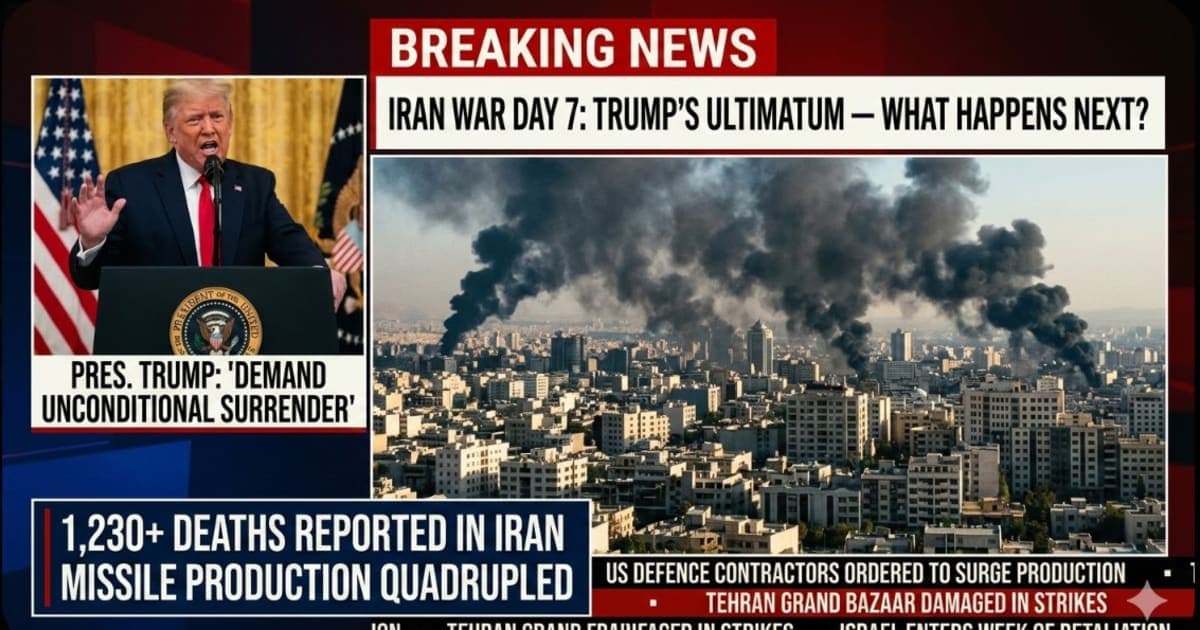
Iran War Day 7: Trump's Ultimatum — What Happens Next?
WASHINGTON, D.C. — Nobody predicted the Middle East would look like this seven days ago. Operation Epic Fury launched on February 28 with the kind of precision that left analysts scrambling for comparisons — and now, a week later, President Trump is pushing harder than ever, demanding Iran's full and unconditional surrender.
Friday's announcement came after Trump sat down with the top executives from Lockheed Martin, Boeing, Northrop Grumman, and Raytheon. The message he walked out with was simple: America isn't stopping.
No Off-Ramps, No Back Channels
Trump took to Truth Social before most of Washington had their morning coffee, and he wasn't mincing words.
"There will be no deal with Iran except UNCONDITIONAL SURRENDER! After that, and the selection of a GREAT & ACCEPTABLE Leader(s), we will work tirelessly to bring Iran back from the brink of destruction. IRAN WILL HAVE A GREAT FUTURE. MAKE IRAN GREAT AGAIN (MIGA!)"
That post did more than close the door on diplomacy — it blew the hinges off. The U.S. isn't just trying to knock out missile sites anymore. Washington wants a different Iran, with different leadership, and Trump made it personal by naming Mojtaba Khamenei — the late Supreme Leader's son — as someone the U.S. won't accept at the helm.
Analysts are calling it the "MIGA doctrine." Call it what you want — it's regime change, even if nobody in the White House is saying those two words out loud.
Quadrupling the Arsenal
The speeches grab headlines, but the factory orders tell the real story. Trump came out of that CEO meeting with a mandate to quadruple production of what he's branding "Exquisite Class" weapons — and he wants contractors running shifts around the clock to get there.
The shopping list is heavy on THAAD and Patriot PAC-3 interceptors for defense, and Tomahawk cruise missiles alongside SM-6 systems on the offensive side. Pentagon planners are quietly war-gaming a campaign that runs three months or longer, and the supply chain is being built to match.
Pete Hegseth, serving as Secretary of War, told reporters the U.S. is "winning decisively" and won't let up until Iran's entire missile manufacturing network is gone. A few Pentagon voices have raised flags about burning through stockpiles too fast, but Trump waved those concerns aside — the U.S. has "virtually unlimited" medium-grade munitions, he said, pointing to their recent use in both Iran and Venezuela.
Back home, governors are already calling their senators. New "Exquisite Class" manufacturing plants mean jobs, and states are lining up to host them.
The Human Cost
A week of airstrikes doesn't stay clean on paper. The casualty figures coming out of the region are sobering.
- Iran — 1,230+ deaths: Tehran's Grand Bazaar took damage, and government buildings across the capital have been gutted
- Lebanon — 217 deaths: Israeli strikes on Hezbollah positions in Beirut have been relentless
- Israel — 12 deaths: Drone and missile retaliation has kept Tel Aviv's airports on and off all week
- United States — 6 service members killed: American troops have died in retaliatory strikes across the region
The killing of Supreme Leader Ali Khamenei on the first day of strikes created a leadership crisis that Tehran is visibly struggling to manage. President Masoud Pezeshkian is still talking tough — he told Washington to "take their surrender demand to their grave" — but the battlefield numbers undercut that bravado. CENTCOM says Iranian ballistic missile launches are down 90% from Day 1. The launch sites are being destroyed faster than they can be used.
What Comes Next?
Going into Day 8, the war's next chapter hinges on three things.
Who runs Iran after this? If the Iranian military keeps fragmenting, Washington may start quietly backing a transitional government — diaspora figures, internal dissidents, technocrats willing to deal. The infrastructure for that kind of operation takes time to build, and the signals suggest it's already being built.
How long can the home front hold? Defense contractors are hiring. Manufacturing towns that haven't seen this kind of activity in decades are suddenly busy. That economic momentum gives the administration real political cover to sustain a long campaign, especially in states that could swing either way in the next election cycle.
Will the region catch fire? Iran has already taken shots at the UAE and Bahrain, trying to force its neighbors off the fence. So far, Trump's personal calls to regional leaders — complete with apologies for collateral disruption and promises of American protection — seem to be holding. The "Axis of Resistance" is looking more isolated by the day.
At roughly $1 billion a day, this is not a cheap gamble. But with the White House budgeting for at least three more months of operations, the era of the Islamic Republic as the world has known it may genuinely be drawing to a close — replaced, if Trump gets his way, by something that didn't exist in anyone's forecast just eight days ago.