Middle East Ablaze: Iran Launches Massive Coordinated Strikes Across Gulf and Mediterranean
Nobody who watched the region closely over the past eighteen months would say this came from nowhere. The warnings were there. The rhetoric was there. The red lines had been crossed and redrawn so many times that most analysts had stopped counting. But when the strikes actually came — simultaneously, in the early hours of Tuesday morning, hitting four countries across two continents — even the most seasoned observers were caught off guard by the sheer scale of it.
Iran didn't fire a warning shot. It fired everything at once.
Ras Tanura Is Burning
The first target was the one that sent the clearest message to the global economy: Saudi Aramco's Ras Tanura refinery complex on the Persian Gulf coast.
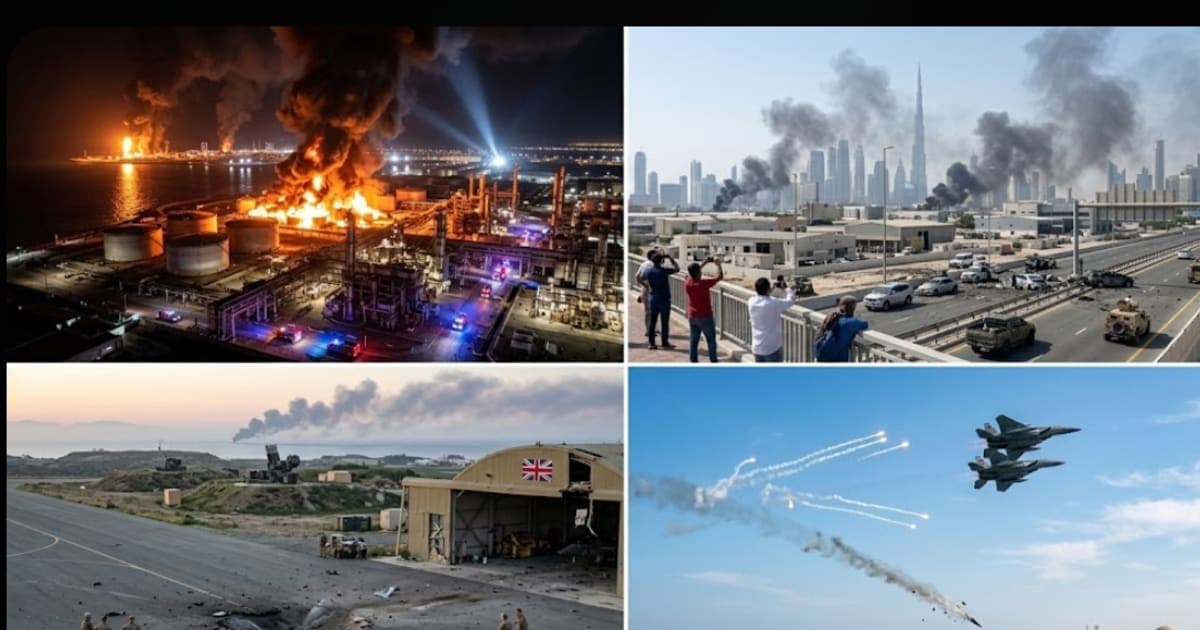
Ras Tanura is not just important to Saudi Arabia. It is one of the largest oil stabilization and export terminals on earth — the kind of facility that, when it goes offline, is felt in petrol stations from London to Lagos within days. In the early hours of Tuesday, a coordinated wave of ballistic missiles and attack drones hit the complex with what witnesses described as multiple direct strikes on storage tanks and processing units.
By sunrise, the fires were visible from miles away.
The Saudi Energy Ministry confirmed what satellite imagery had already shown — the facility had been hit, emergency crews were battling the blazes, and the full extent of the damage was still being assessed. What was already clear, even in those first hours, was that global oil prices were not going to wait for a damage report. Markets reacted immediately, with crude spiking sharply on fears of prolonged supply disruption.
For years, Iran had threatened to target regional energy infrastructure if its own oil exports were strangled by sanctions. On Tuesday morning, that threat became reality.
Dubai: The Strike Nobody Expected
At virtually the same moment Ras Tanura was being hit, explosions were being reported in the UAE — specifically in and around Dubai, the commercial capital of the Gulf and arguably the region's most carefully constructed symbol of stability and international business confidence.
Social media footage showed smoke rising from industrial areas. Dubai International Airport — one of the busiest in the world — briefly suspended operations. Emirati authorities, initially cautious with their public statements, confirmed that damage to civilian infrastructure had occurred. Casualty figures were not immediately released.
The choice of Dubai as a target was deliberate and pointed. The UAE had been quietly pursuing diplomatic engagement with Iran for several years, attempting to manage the relationship rather than inflame it. Tehran's decision to strike Dubai anyway sent a message that was impossible to misread: no amount of dialogue would protect you if Iran decided you were in the way.
The economic consequences for a city that runs on trade, tourism, and international confidence are expected to be severe and lasting. Investors and multinational firms that had treated Dubai as a stable regional base are now reassessing that assumption in real time.
Cyprus: Iran Reaches Into Europe
The strike that genuinely shocked Western governments was not in the Gulf at all.
RAF Akrotiri, the UK's sovereign military base on the southern coast of Cyprus, was struck by Iranian projectiles — confirmed by the British Ministry of Defence, which stated that several had landed within the base perimeter. There were no personnel casualties, officials said, though damage assessments were ongoing.
The significance of this strike is hard to overstate. Akrotiri is not just a British base. It is a critical node for British and NATO operations across the Eastern Mediterranean and the wider Middle East. Hitting it was Iran declaring, clearly and publicly, that its missile capability now extends well beyond its immediate neighbourhood — and that it is willing to use it against Western military infrastructure.
For the United Kingdom, the question of how to respond is now unavoidable. And because of NATO's collective defence obligations, that question does not belong to London alone.
Qatar Shoots Down Iranian Jets
In what may ultimately prove to be the most geopolitically consequential single incident of the day, Qatar's Ministry of Defence announced that its air defence forces had shot down two Iranian fighter jets over Qatari territorial waters, after the aircraft violated its airspace during the coordinated assault.
Qatar engaging Iranian military aircraft directly is not a minor footnote. Doha has spent years positioning itself as the Gulf's neutral diplomatic channel — the country that keeps lines open with Tehran when everyone else has closed them. The fact that Qatar felt compelled to open fire reflects just how completely the normal rules of regional engagement collapsed in a matter of hours.
It also narrows the options for de-escalation. If Iran and Qatar — historically among the more functional relationships in the region — are now in a direct military confrontation, the remaining diplomatic pathways are very thin.
Tehran's Message to the World
Iranian state media claimed responsibility quickly and without ambiguity. The IRGC issued a statement that was equal parts warning and declaration of doctrine: "The era of hit-and-run is over."
The architecture of the strikes — four countries, two continents, multiple asset types simultaneously — was clearly designed to demonstrate something specific: that Iran's military reach is real, that its drone and missile programme has matured into a genuine multi-theatre capability, and that it can overwhelm regional air defences through sheer volume and coordination.
Whether this was a calibrated show of force intended to deter further escalation, or the opening move in something larger, is the question every government in the region is now trying to answer.
A World Scrambling to Respond
The international reaction came fast, if not yet with any clear direction.
US officials condemned the attacks as "reckless and destabilising," reaffirmed their commitment to regional allies, and said all options remained on the table. The UN Secretary-General called for maximum restraint. Emergency sessions of both the Gulf Cooperation Council and the UN Security Council were convened within hours.
Saudi Arabia and the UAE are under enormous domestic pressure to respond to direct strikes on their soil. The UK is working through what a proportionate response to Akrotiri looks like — and whether it triggers any NATO consultation process. Every military in the region is at heightened alert.
Meanwhile, the Strait of Hormuz — the narrow waterway through which roughly a fifth of the world's oil passes — is now under the shadow of potential Iranian interdiction. Shipping companies are watching closely. So are insurance markets. So is every economy on earth that depends on stable energy prices, which is to say all of them.
What Comes Next
The honest answer is that nobody is certain — including, in all likelihood, the governments making the decisions.
What is certain is this: the Middle East that existed on Monday no longer exists on Wednesday. The strikes on Ras Tanura, Dubai, Akrotiri, and Qatar's territorial waters have shattered whatever remained of the regional status quo. The mechanisms that usually slow these situations down — diplomatic back-channels, economic interdependence, the mutual interest in not blowing everything up — are all under severe strain simultaneously.
The next 72 hours will be watched more closely than any period in the region's recent history. Whether what follows is a managed de-escalation or the beginning of something far longer and far worse depends on decisions being made right now, in capitals where the pressure to retaliate is running very high and the patience for restraint is running very low.
All figures and damage assessments cited in this report reflect information available at time of publication. The situation remains rapidly developing.