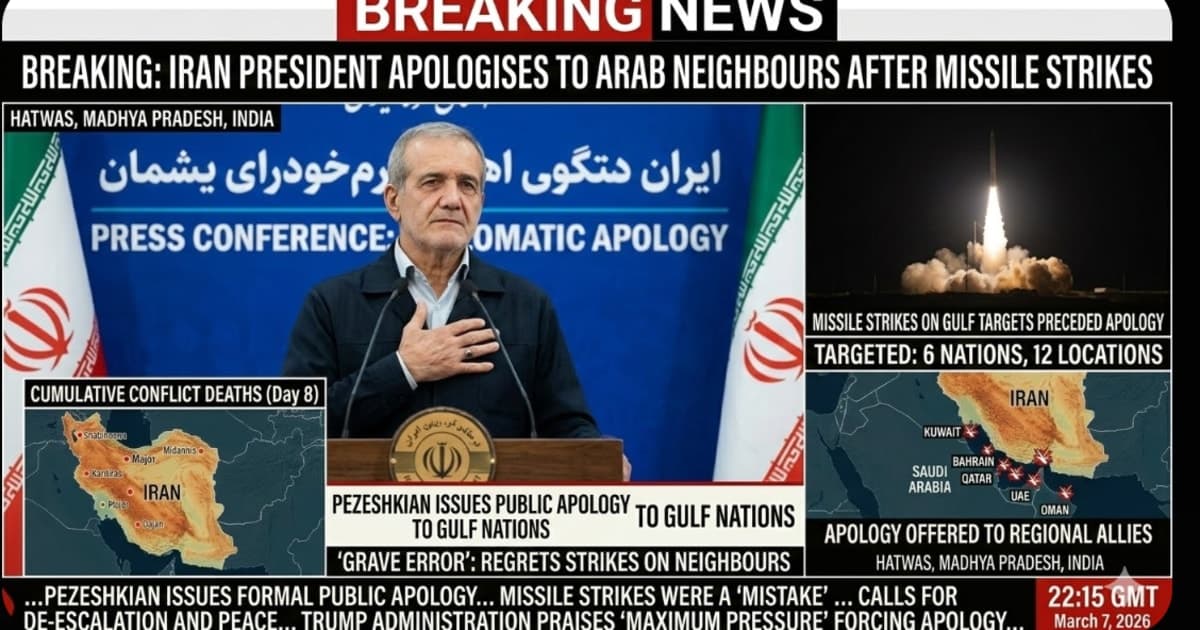
Breaking: Iran President Apologises to Arab Neighbours After Missile Strikes
DUBAI / TEHRAN, March 7, 2026 — In one of the most unexpected diplomatic moments of the entire conflict, Iranian President Masoud Pezeshkian appeared on state television Saturday morning and did something no one in the region saw coming — he said sorry.
In a prerecorded address broadcast to the nation and the world, Pezeshkian issued a direct public apology to the Gulf Arab countries that Iranian missiles and drones have been striking for the past week. The statement landed like a thunderclap across diplomatic circles from Riyadh to Abu Dhabi — and the timing made it even more extraordinary. [web:18]
The apology came hours after Iranian attacks had already hit Bahrain, Saudi Arabia, and the UAE that very same morning. [web:27]
The Words That Stunned the Gulf
Pezeshkian didn't bury the apology in diplomatic language. He put it right at the front.
"I must apologise on my own behalf and on behalf of Iran to the neighbouring countries that were attacked by Iran. The interim leadership council agreed yesterday that no more attacks will be made on neighbouring countries and no missiles will be fired unless an attack on Iran originates from those countries." [web:22]
It was a remarkable sentence for a wartime leader to deliver — an admission that Iran had been striking countries it now says it never intended to turn into enemies. [web:21] The address also revealed something that had not been publicly confirmed before: the Interim Leadership Council, the body governing Iran following the death of Supreme Leader Khamenei on February 28, had previously granted the military "fire at will" authority. [web:24] That authority has now been revoked. [web:24]
The message was clear — Tehran is trying to draw a hard line between its war with the U.S. and Israel, and its relationship with the Arab world sitting in the middle of it.
What Iran Actually Hit Over the Past Week
The apology didn't come out of nowhere. The list of targets Iranian forces struck across the Gulf over the past eight days is striking in both its breadth and its recklessness.
- Dubai: Explosions near Dubai International Airport — the world's busiest airport for international travel — disrupted flights and sent passengers scrambling into train tunnels for shelter [web:23]
- Palm Jumeirah & Burj Al Arab: Drone strikes hit two of Dubai's most iconic landmarks, with footage of fires spreading rapidly on social media [web:19]
- UAE: Drone debris caused a fire at the U.S. consulate in Dubai [web:19]
- Bahrain: An Iranian missile struck a state-run oil refinery, one of the most significant infrastructure hits of the conflict [web:19]
- Saudi Arabia: Drones targeted the Shaybah oil field; a ballistic missile was launched toward Prince Sultan Air Base, which hosts U.S. forces [web:25]
- Qatar: 14 ballistic missiles and four drones were fired at the country — one of them hitting Al-Udeid base [web:19]
These weren't stray shots in the dark. They were sustained attacks on countries that are not formally parties to the conflict — countries that host U.S. bases, yes, but also countries that share long economic and diplomatic ties with Iran. [web:23]
The Catch: It Was Already Happening Again
There is a detail buried in Saturday's events that makes the apology more complicated than it appears on the surface.
Pezeshkian's address aired on state television — and within hours of it broadcasting, Qatar reported intercepting a fresh missile attack. [web:20] Sirens sounded again in Bahrain. [web:23] The gap between what the president said in a prerecorded video and what Iran's armed forces were actually doing on the ground suggested something troubling: Tehran's political leadership may not have full command and control over its own military. [web:23]
That disconnect — a president apologizing while missiles are still flying — is one of the more unsettling signals to emerge from Day 8 of Operation Epic Fury. It raises the question of whether Pezeshkian's announcement reflects actual policy or whether it is aspirational, a statement of intent that the fractured military chain of command may not yet be following. [web:21]
Still Defiant on Surrender
Whatever softening Pezeshkian showed toward the Gulf states, he showed none toward Washington.
In the same address, he flatly rejected Trump's demand for unconditional surrender, calling it a "dream that they should take to their grave." [web:25] He was not offering the U.S. or Israel the same de-escalation gesture he extended to Arab neighbours — only a ceasefire of sorts with countries Iran says it never meant to fight in the first place.
The U.S., meanwhile, is moving in the opposite direction. The Trump administration authorized a new $151 million arms sale to Israel on Saturday, and officials warned that the most intense bombing campaign of the entire conflict is still ahead. [web:18]
Why the Gulf States Are Not Celebrating Yet
For Saudi Arabia, the UAE, Bahrain, and Qatar, the apology is welcome — but trust is not something eight days of missile strikes rebuilds overnight.
These countries have spent a week activating air defenses, evacuating civilians, rerouting flights, and watching oil infrastructure burn. The economic damage is real. Dubai International Airport, which handles millions of passengers weekly, has been repeatedly disrupted. [web:20] The Shaybah oil field attack alone rattled energy markets.
Gulf leaders are also aware that the ceasefire Pezeshkian announced is conditional — Iran will hold its fire unless it perceives an attack originating from their territory. Given that these countries host American bases that are actively participating in Operation Epic Fury, that condition is not as reassuring as it might sound. [web:17]
What It Signals for the Wider Conflict
Strip away the diplomatic language and Saturday's apology tells a specific story about where Iran finds itself on Day 8.
The country is fighting a war on multiple fronts simultaneously — absorbing relentless U.S.-Israeli airstrikes, managing a leadership crisis after the death of its Supreme Leader, and now realizing that its strategy of widening the conflict by striking Gulf states has backfired. Rather than drawing neighbours into the fight or forcing them to pressure Washington, Iran's attacks appear to have done the opposite — isolating Tehran and pushing Gulf governments closer to the American position. [web:21]
The apology is a course correction. It is Iran's way of saying: we made a mistake in that direction, and we are pulling back from it.
What it is not — and Pezeshkian made this explicit — is any kind of opening toward the United States. Iran is not surrendering. It is not negotiating. It is trying to survive the next phase of a war it cannot win militarily while holding onto enough political credibility to determine what comes after.
Whether that calculus works depends on what Washington orders next — and Trump's team has already signalled that the hardest strikes are still to come. [web:18]