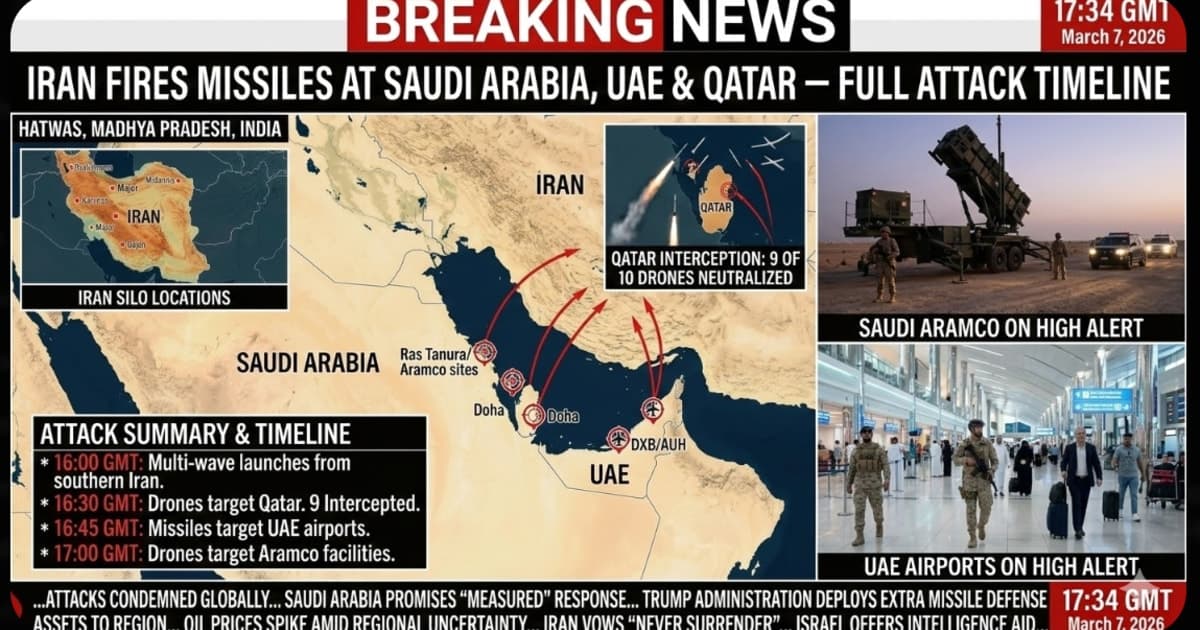
Iran Fires Missiles at Saudi Arabia, UAE & Qatar — Full Attack Timeline
DOHA / DUBAI / RIYADH, March 7, 2026 — For eight straight days, the skies above the Gulf have been anything but peaceful. While the world's attention has been fixed on the burning skyline of Tehran, a parallel war has been playing out over some of the world's most economically critical real estate — Dubai's airports, Saudi Arabia's oil refineries, and Qatar's American military installations.
Iran came for all of it.
What began as a campaign of retaliation against U.S. military bases has spiraled into one of the most sustained missile and drone offensives ever directed at Arab Gulf nations — countries that are not parties to the conflict, but happen to be hosting the American forces that are. The numbers, accumulated across eight days, are staggering. [web:35]
Day 1 — February 28: The Opening Barrage
The ink on the Operation Epic Fury launch orders was barely dry when Iran's first salvos were already crossing Gulf airspace.
On the very first day of the conflict, Iran launched at least 247 ballistic missiles and 230 drones across three Gulf states simultaneously. [web:36] The UAE alone absorbed an estimated 137 ballistic missiles and 209 drones in a single night. Bahrain — home of the U.S. Navy's 5th Fleet — took 45 missiles and 9 drones. Qatar, where Al-Udeid Air Base hosts the largest American military installation in the entire Middle East, faced 65 ballistic missiles and 12 drones. [web:36]
Parts of the 5th Fleet headquarters in Bahrain were visibly hit in that opening attack. Video of the damage spread within hours. [web:35]
The UAE Ministry of Defense scrambled everything it had — by the time the dust settled from the opening days, its air defense systems had dealt with 165 ballistic missiles, 2 cruise missiles, and 541 Iranian drones. [web:35]
The Full Scorecard: Gulf States Under Fire
Here's what each country absorbed across the first week of the conflict:
| Country | Ballistic Missiles | Drones | Notable Hits |
|---|---|---|---|
| UAE | 165+ | 541+ | Dubai Airport disrupted, Burj Al Arab area struck, US consulate fire |
| Kuwait | 97 | 283 | All intercepted per government |
| Qatar | 65+ | 12+ | Al-Udeid Air Base struck, Qatar Airways suspended |
| Bahrain | 45 | 9 | 5th Fleet HQ partially hit, sirens multiple times |
| Saudi Arabia | Multiple | Multiple | Ras Tanura refinery hit, Riyadh airport targeted |
| Jordan | 13 | 36 | Interceptions confirmed |
[web:36]
Saudi Arabia: Aramco in the Crosshairs
Of all the targets Iran chose, none sent a louder message to global energy markets than the Ras Tanura refinery — Saudi Aramco's flagship facility and one of the largest oil refineries on earth.
Iranian drones struck the refinery on March 1, forcing a temporary shutdown. [web:41] Saudi Aramco's media office stayed quiet for hours before the defense ministry confirmed that two drones targeting the facility had been intercepted — but not before a fire broke out from debris, visible on satellite imagery shared by energy analysts. [web:41]
The message was deliberate. Iran wasn't just trying to hit U.S. bases. It was trying to torch the global oil supply chain and force the world to feel the economic pain of a war it didn't start. [web:38]
Saudi Arabia has since intercepted two ballistic missiles aimed at Sultan Air Base in Al-Harj, six drones approaching the Shaybah oilfield, and a separate drone east of Riyadh — all in a single 24-hour window on Saturday alone. [web:37]
Dubai: The World's Busiest Airport Goes Dark
Dubai International Airport — the busiest international airport on the planet — has been the Gulf's most visible casualty of Iran's drone campaign.
Explosions rattled the airport perimeter multiple times across the week. The government's Dubai Media Office initially described a "minor incident from debris falling after an interception" — but Emirates Airlines told a different story, suspending all flights to and from Dubai until further notice. [web:37] Flightradar24 showed dozens of inbound aircraft circling in holding patterns over the city, unable to land. [web:37]
A drone strike also hit the U.S. consulate in Dubai, sparking a fire that was contained without casualties — but the image of flames at an American diplomatic post in one of the world's most cosmopolitan cities landed hard across international media. [web:39]
Qatar: Al-Udeid Takes a Hit
Iran's most strategically significant Gulf target was always Al-Udeid Air Base in Qatar — the nerve center of U.S. Central Command and the hub from which much of Operation Epic Fury is being coordinated.
Qatar faced wave after wave. On February 28 alone, 65 ballistic missiles and 12 drones came in. [web:36] Qatar's air defenses intercepted the majority, but falling debris ignited fires in industrial areas near Doha. [web:36] By Day 5, a ballistic missile had broken through — the Ministry of Defense confirmed it struck near the base, though the extent of damage was not disclosed. [web:39]
On Saturday — Day 8 — Iran fired another 10 drones at Qatar. Nine were intercepted. One reached the ground in a "desolate area," according to Qatar's Defense Ministry. [web:37] Qatar Airways, one of the world's premier carriers, suspended operations entirely for several days, only partially resuming through emergency contingency routes designated for evacuation flights. [web:37]
Qatar's Prime Minister had already had enough by Day 6. After Iran's foreign minister called to claim the strikes were "aimed at U.S. interests" and not Qatar itself, the PM rejected the explanation outright — calling the attacks a "flagrant violation of Qatar's sovereignty" and accusing Tehran of dragging neighbors into "a war that is not theirs." [web:33]
The Apology That Changed Nothing on the Ground
On Saturday morning, President Pezeshkian issued a public apology to Gulf nations and announced that Iran's Interim Leadership Council had revoked the military's "fire at will" authority against neighboring countries. [web:22]
Within hours, missiles and drones were flying again.
Saudi Arabia intercepted fresh attacks. Sirens sounded in Bahrain for the second time that day. Qatar's air defenses were active through the night. [web:37] The gap between the president's words on state television and what Iran's military was actually doing pointed to something deeply worrying — a command-and-control structure that may no longer be operating as a single coherent unit. [web:23]
What It Means for Oil, Aviation and the Global Economy
The ripple effects of eight days of Gulf strikes are already showing up in ways that have nothing to do with military strategy.
Global oil prices have crossed $89 per barrel, driven in part by the attack on Ras Tanura and the uncertainty hanging over every Gulf energy facility. [web:38] Insurance premiums for tankers transiting the region have tripled. Dubai's status as a global transit hub has taken a serious reputational hit — airlines from Asia to Europe are rerouting around UAE airspace entirely.
And the attacks haven't stopped. Iran has fired hundreds of missiles and drones at countries that had no formal role in the war against it — countries that now have every reason to quietly support any outcome that ends the threat permanently.
That political reality, more than any military calculation, may ultimately shape how this war ends.