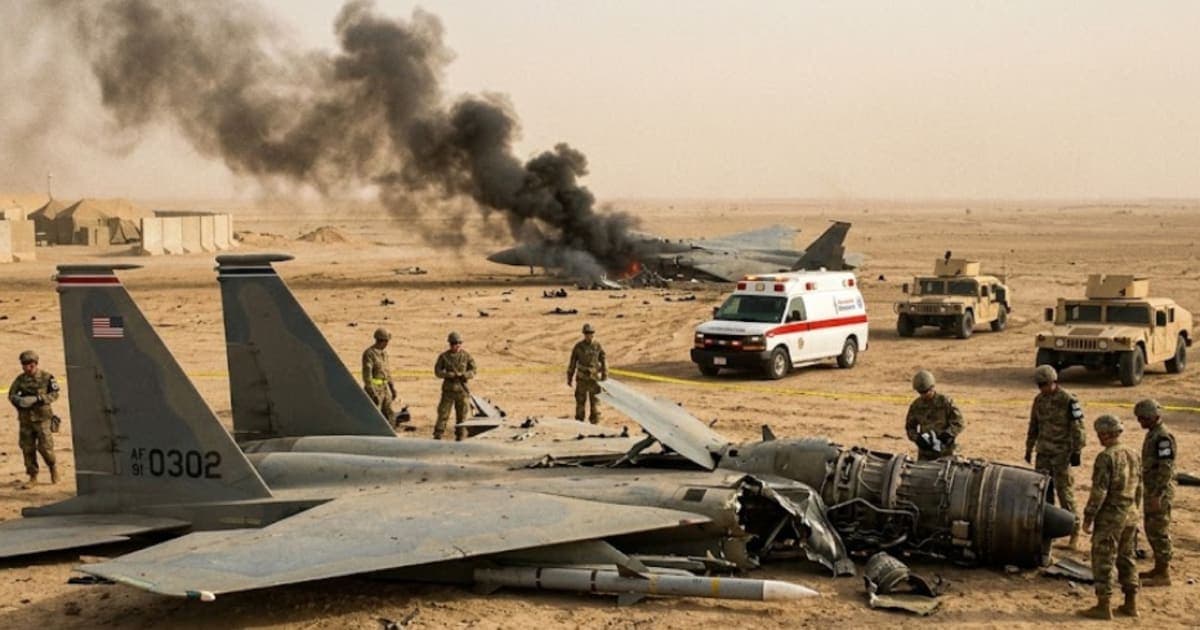
Three F-15s Down Over Kuwait. Shot by Their Own Side.
At 02:45 AM local time on Monday, somewhere over the western Kuwaiti desert, three United States Air Force F-15E Strike Eagles were destroyed. Not by Iranian missiles. Not by Hezbollah drones. By a U.S. Army Patriot battery stationed at a nearby base, which locked onto the jets and fired.
The pilots were flying a maritime protection patrol. They never saw it coming.
Senior Defense Department officials, speaking without attribution, are calling it a "worst-case outcome." That is the kind of phrase that gets used when the language of military briefings runs out of adequate options. Three F-15s — aircraft with an unblemished air-to-air combat record stretching back decades — gone in a matter of seconds, destroyed by the very air defense architecture they were operating inside.
No confirmed fatality count yet. Notification of next of kin still pending. The wreckage is scattered across several dozen miles of remote desert north of Kuwait City.
What Happened, as Best as Anyone Can Determine
The three Strike Eagles were flying in tight formation at low altitude — a tactic designed to improve survivability in contested airspace. In this specific situation, that tactic worked against them.
The Patriot battery was operating under what multiple sources are describing as a "hair-trigger" alert status. The region was saturated with aircraft — allied jets, American jets, Israeli assets, threat warnings cycling through the system continuously. The operators had been briefed on potential retaliatory Iranian strikes following recent Israeli operations on Iranian infrastructure. Everything coming in was a potential threat.
The tight formation of three F-15s, flying low and fast, showed up on the battery's radar as something that looked, in the compressed seconds available for a decision, like a salvo of incoming cruise missiles or drones.
The IFF — Identification Friend or Foe — system failed to interrupt the engagement sequence in time. The operators fired.
"A perfect storm of tactical confusion," is how one defence official familiar with the preliminary findings described it. "Multiple layers of air defense, dozens of allied aircraft in the air, a high-threat warning status, and a communication system failure at the critical moment. The standard multi-layered identification process completely broke down."
Eyewitnesses near the impact sites described multiple bright streaks of light — the Patriot interceptors — followed by mid-air explosions in rapid succession. Search and recovery teams, including special operations units, reached the scene immediately. Their job was to locate survivors and secure classified technology from three of the most advanced fighter aircraft the U.S. Air Force operates.
What This Means for the Air Force and the Army
The F-15's combat record is one of the most cited statistics in American military history — over 100 aerial victories, zero losses in air-to-air combat. That record is technically intact. These jets weren't shot down by an enemy.
That distinction will not feel like much comfort at Langley Air Force Base or in the Pentagon's E-ring right now.
For the Army, the Patriot system — the crown jewel of U.S. theatre missile defence, the asset that has been deployed to protect allied nations across the Middle East for decades — has now destroyed three American aircraft in a single engagement. The reputational damage to the platform is significant. The institutional damage, as the Army and Air Force spend the coming weeks trading blame through official and unofficial channels, will be worse.
The investigation will go all the way up. From the operators at the battery, to the battery commander, to the CENTCOM air operations centre that was supposedly coordinating the airspace, to the generals at the top of the chain who set the alert conditions that created a hair-trigger environment. Someone will be accountable. The question is how many people, and at what rank.
Markets Noticed Immediately
Brent crude jumped over 3% in a single move on the news, briefly touching near $80 per barrel on top of prices already elevated by the broader regional conflict.
The logic in the trading rooms was not complicated. A U.S. military that has just lost three of its own aircraft to its own air defenses is, in the market's assessment, a U.S. military operating under conditions of greater confusion than previously understood. Greater confusion means greater risk of miscalculation. Greater risk of miscalculation means the conflict could go directions that nobody has priced in yet.
"The market is no longer just pricing in a U.S.-Iran conflict," one London-based energy analyst said. "It's pricing in a potential collapse of U.S. command and control. The perception of an infallible U.S. military umbrella has been punctured, and that creates massive uncertainty."
That is perhaps overstated. The U.S. military remains enormously capable and this is one incident, not a pattern. But markets price perception as much as reality, and the perception on Monday morning was of an operation fraying at the edges.
Tehran, Washington, and the Politics of a Bad Day
Iranian state media had the story up within hours. The framing was predictable and, in this instance, they didn't have to work very hard at it. Three American jets. Downed by Americans. In a war America started. The propaganda writes itself.
The more consequential reaction is in Washington and Tel Aviv.
In the Senate, the Armed Services Committee is demanding answers. The phrase "fog of war" — the traditional military explanation for everything that goes wrong — has already been pre-emptively dismissed by at least one senior lawmaker as inadequate for what happened here. Friendly fire incidents occur in warfare. Three F-15s in a single engagement, destroyed by the air defense network they were operating within, is not a routine fog-of-war incident. It is a systemic failure.
For Israel, which depends on close coordination with American air assets and American-controlled air defense systems for its ongoing operations against Iranian infrastructure, the incident raises a question that will be asked privately and urgently: if the IFF system failed here, under these conditions, what does that mean for joint operations in a higher-intensity scenario?
That conversation is happening right now in Tel Aviv. The answers are not good.
The Larger Problem the Incident Exposed
The Pentagon has spent years and billions of dollars on a concept called JADC2 — Joint All-Domain Command and Control — the ambition to seamlessly connect every sensor and shooter across every service branch into a single coherent operational picture.
Monday morning's events over Kuwait are a direct test of that ambition. The test was failed.
The IFF system is not new technology. The Patriot is not new technology. The protocols for deconflicting airspace in a combined arms environment are not new. What failed was not any single piece of equipment but the integration of all of it under high-stress, time-compressed, high-alert conditions — which is precisely the scenario that the entire JADC2 programme is designed to manage.
If the system can't handle three F-15s on a patrol route without destroying them, the questions about what happens in a genuine multi-domain conflict — the Taiwan scenario, the simultaneous-front scenario — become significantly more uncomfortable.
The Pentagon will ground non-essential Patriot operations across the theatre. A full joint-service investigation will be launched and will run for months. The engagement protocols will be revised. Training will be overhauled. Accountability will be assigned.
None of that brings back the three aircraft or the people who were in them.
A Desert Full of Questions
The wreckage is spread across remote desert, a few dozen miles north of Kuwait City. Recovery teams are working the scene. Classified components are being secured. Families are being notified.
The U.S. military has absorbed setbacks before and recovered. It will recover from this. But the timing — in the middle of an active regional conflict, with oil prices already elevated, with Iranian propagandists watching, with Israeli partners quietly reassessing, with Congressional patience for open-ended operations already thin — means that the recovery has to happen in public, under pressure, while everything else is still moving.
That is a harder recovery than most.
Official casualty figures and investigation findings were not available at time of publication. The Pentagon has confirmed the incident and indicated a formal statement will follow next-of-kin notifications.