US Loses 92,000 Jobs in One Month — Is a Recession Coming?
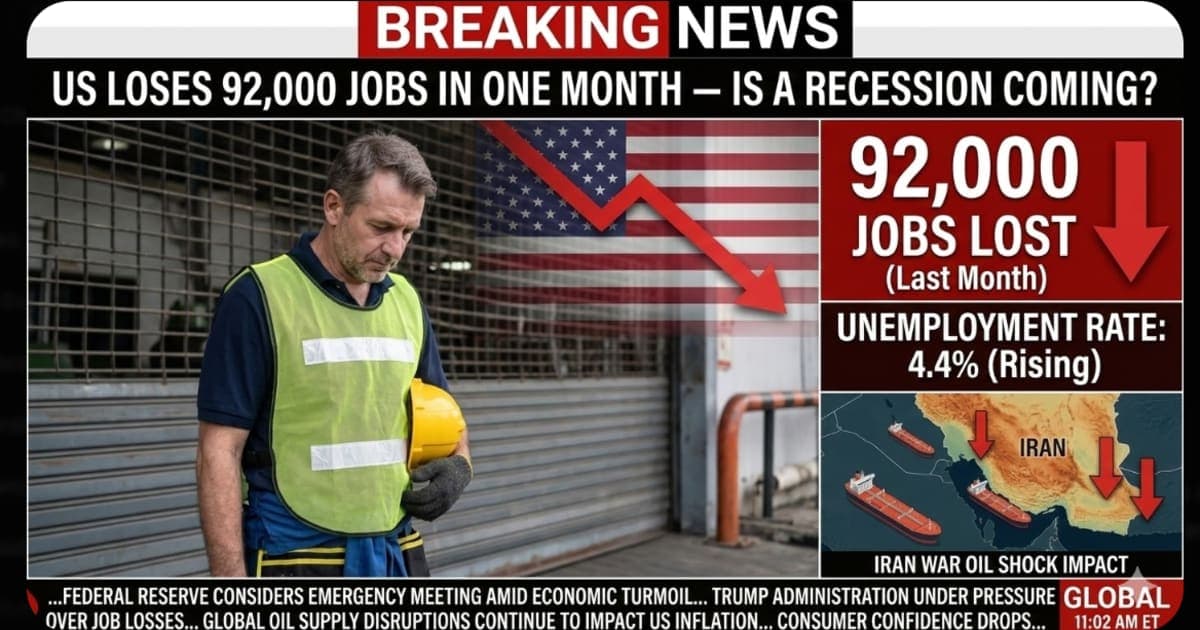
WASHINGTON, March 7, 2026 — Friday was supposed to be a day of good economic news. Analysts had penciled in 60,000 new jobs for February. Instead, when the Bureau of Labor Statistics report dropped at 8:30 AM Eastern, the number staring back at Wall Street was negative 92,000. [web:91]
Dow futures dropped hundreds of points within minutes. And that was before the latest Gulf escalation headlines started rolling in. [web:95]
Two separate shocks — one economic, one military — hit the American public on the same morning. And together, they are raising a question that economists have been careful to avoid saying out loud: is the United States sliding into a recession it wasn't prepared for?
The Number That Nobody Expected
Economists expected 60,000 new jobs. Instead, employers cut 92,000. That's a miss of 152,000 jobs in a single month — the worst monthly decline since October of last year. [web:97]
It didn't stop there. Revisions to December and January payrolls quietly removed another 69,000 jobs from the record. [web:94] That means the labor market, already fragile going into February, was even weaker than it looked at the time.
The unemployment rate ticked up to 4.4%. [web:89] That number alone doesn't scream crisis — but the direction it's moving, combined with the context surrounding it, is what has economists genuinely worried.
"Just when it looked like the labor market was stabilizing, this report delivers a knock-down blow to that view," said Olu Sonola, head of U.S. economics at Fitch Ratings. "It's bad news whichever way you look at it." [web:94]
Where the Jobs Went — Sector by Sector
The losses weren't concentrated in one corner of the economy. They were everywhere.
- Healthcare — 28,000 jobs lost: The sector that has propped up employment numbers for two years straight suddenly collapsed, almost entirely due to a four-week strike by more than 30,000 nurses and frontline workers at Kaiser Permanente facilities in California and Hawaii [web:94]
- Restaurants and bars — 30,000 jobs lost: Leisure and hospitality, still fragile from years of post-pandemic restructuring, took one of its worst monthly hits in recent memory [web:92]
- Manufacturing — 12,000 jobs lost: Factories have now shed jobs in 14 of the last 15 months — a slow-motion contraction that rarely makes headlines but tells a grim story about American industrial health [web:91]
- Construction — 11,000 jobs lost: Partly weather-related — frigid temperatures froze job sites across multiple states in February [web:94]
- Administrative services — 19,000 jobs lost: White-collar support roles are disappearing, with AI-driven automation accelerating a trend that predates the Iran war entirely [web:95]
- Federal government — 10,000 jobs lost: Public sector employment continues its contraction, down significantly since 2024 [web:97]
- Finance — gained 10,000 jobs: One bright spot, but analysts note that cuts elsewhere in the financial sector are continuing [web:92]
The Iran War's Fingerprints Are All Over This
The February jobs report covers data from before Operation Epic Fury launched on February 28 — which means the war's economic damage isn't fully in these numbers yet. What's visible are the pre-war tremors: months of uncertainty driven by Trump's tariff policy, high interest rates, and a business community that had been reluctant to hire even before a Middle East conflict sent oil prices surging. [web:92]
What happens next month, when February's wartime oil spike feeds into March's data, is the question keeping economists up at night.
Gas prices have already hit their highest average levels of either of Trump's presidential terms. [web:93] Crude oil is sitting above $89 per barrel and climbing. [web:95] The Strait of Hormuz — through which roughly 20% of the world's oil and LNG supply moves — is effectively disrupted. [web:97]
"The nature of gas prices is really interesting because as oil prices rise, those increases fall through to consumers basically immediately," one analyst noted on Friday. [web:93] Higher gas prices mean higher delivery costs. Higher delivery costs mean higher prices on everything — groceries, goods, services. Consumer spending, which drives about 70% of U.S. economic activity, was already showing signs of strain before the war. Retail sales unexpectedly declined in January. [web:93]
"Companies are going to be even more reluctant to hire this spring until the war ends and they can see consumers still spending," said Heather Long, chief economist at Navy Federal Credit Union. "It's a tense time for the U.S. economy." [web:92]
The Stagflation Alarm
There is a word that serious economists are starting to use — carefully, cautiously, but use nonetheless.
Stagflation.
The last time the United States experienced it meaningfully was the 1970s — a period of simultaneous economic stagnation and rising inflation, driven in large part by an oil shock from the Middle East. The parallel to 2026 is not subtle. [web:95]
The Federal Reserve is now caught in the worst possible bind. Inflation is rising because of oil prices — which calls for higher interest rates to cool it. But the job market is weakening and economic growth is slowing — which calls for cutting rates to stimulate activity. Both pressures exist simultaneously, and monetary policy can't solve both at once. [web:95]
Goldman Sachs and Wells Fargo analysts, cited in financial reporting this week, warn that crude oil could reach $150 per barrel if the Hormuz disruption extends beyond 60 days. [web:95] At that price level, the economic damage stops being a quarterly blip and starts looking like a structural shock.
What the Numbers Have Been Saying All Year
The February report doesn't arrive in isolation. It is the latest data point in a trend that has been building for over a year.
| Month | Jobs Added/Lost | Unemployment |
|---|---|---|
| 2025 Average | +15,000/month | 4.1% |
| December 2025 | Revised downward | 4.2% |
| January 2026 | +126,000 | 4.3% |
| February 2026 | -92,000 | 4.4% |
[web:91][web:92]
January's 126,000 jobs had felt like a turning point. Analysts called it a sign that the labor market was finally finding its footing after a sluggish 2025 defined by tariff uncertainty and the lingering drag of high interest rates. [web:92]
February erased that optimism in a single report.
Trump's Response — and the Defense Spending Offset
Trump, in a phone interview with CNN on Friday, was unbothered. "The rise in prices is short term," he said, framing the economic turbulence as a temporary cost of a necessary military operation. [web:93]
The White House is leaning on a different economic argument — the defense production surge. The mandate to quadruple output at Lockheed Martin, Boeing, Northrop Grumman, and Raytheon has the administration pitching a wartime industrial stimulus: new manufacturing plants, new shifts, new jobs in states that haven't seen this kind of activity in years.
It's a real argument. Defense spending does create jobs. But those jobs take months to materialize — and the families who lost work in healthcare, restaurants, construction, and manufacturing last month aren't waiting months. They needed those paychecks in February.
Is a Recession Coming?
The honest answer from economists who aren't trying to spin anything: it depends almost entirely on how long the Iran war lasts.
A short, decisive conflict — resolved in four to six weeks as the White House projects — means oil prices normalize, business confidence returns, and the February jobs report looks like a painful but temporary blip in the data. The labor market has absorbed worse.
A prolonged conflict — three months or more of Hormuz disruption, sustained $100-plus oil, and a consumer sector that stops spending because every dollar is going into the gas tank — is a different calculation entirely. That scenario puts recession odds above 50% by most models currently circulating on Wall Street. [web:95]
The war is costing the U.S. an estimated $1 billion per day militarily. The economic cost, less visible but building day by day in fuel prices and frozen hiring decisions, may end up being larger.
February's jobs report was the first bill arriving in the mail. More are coming.