Nepal Election Results 2026: Balendra Shah Wins Big — Impact on India
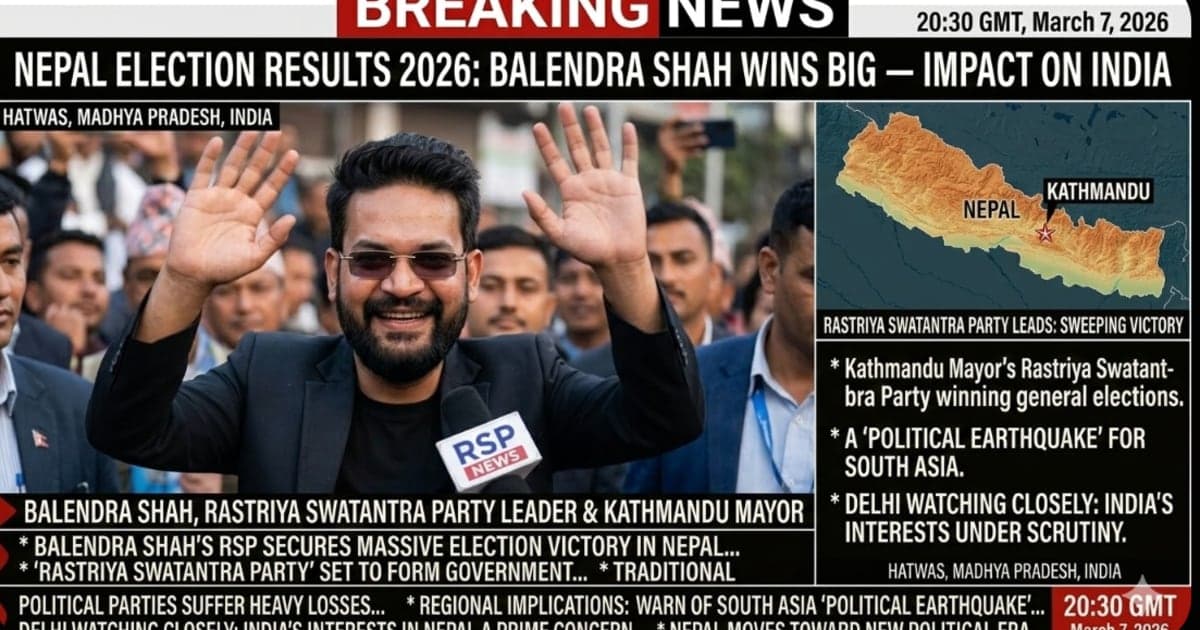
KATHMANDU, March 7, 2026 — Nepal just rewrote its own political history, and a 35-year-old rapper-turned-mayor is the one holding the pen.
Balendra "Balen" Shah's Rastriya Swatantra Party has swept Nepal's 2026 general elections in a landslide that nobody in the country's old political establishment saw coming — or could stop. RSP has already won 41 seats and leads in 78 more out of 165 first-past-the-post constituencies. [web:83] KP Sharma Oli's CPN-UML, once the dominant force in Nepali politics, is clinging to single digits. The Nepali Congress — another pillar of the old order — has secured just four seats. [web:79]
Nepal has had 14 governments in the last 18 years. The country's Gen Z just decided it was done with all of them. [web:75]
The Man Who Won — Balen Shah
He started as a rapper. Then he became Kathmandu's mayor in 2022, cleaned up the city's chaotic streets, demolished illegal structures that had survived decades of political protection, and turned himself into the most talked-about politician in Nepal — almost entirely on the strength of actually doing things.
The RSP was only formally launched ahead of these elections. It didn't have the organizational machinery of the old parties, the decades of cadre loyalty, or the rural patronage networks that Nepali politics has always run on. What it had was Balen Shah and a generation of young voters who were done waiting. [web:74]
In Jhapa-5 — the home constituency of KP Sharma Oli, the former Prime Minister and CPN-UML chairman — Shah beat Oli by a margin that wasn't even close. Shah polled 39,284 votes. Oli managed 10,293. [web:79] The man who once ran Nepal's government lost his own seat to the man who used to rap about it.
What Drove the Earthquake
The 2026 election didn't happen on schedule. It was forced early — triggered by the Gen Z protests that erupted in September 2025, toppled the KP Oli coalition government, dissolved parliament, and handed power to an interim administration under Supreme Court Chief Justice Sushila Karki. [web:80]
Those protests weren't just about any single policy. They were about 18 years of musical-chairs governance — the same rotating cast of faces, the same corruption, the same broken promises — and a generation that had grown up watching Nepal's political class treat the country like a personal inheritance. [web:77]
When voting opened on March 5, 18.9 million eligible voters turned out — including over 915,000 new first-time voters, 52% of the electorate aged between 18 and 40. [web:80] That demographic handed RSP the mandate that the old parties spent decades accumulating and lost in a single election cycle.
RSP's manifesto — packaged as a legally binding "Bacha Patra" or Citizen Contract — promised $30 billion in IT exports, aggressive hydropower monetization, probes into public assets misused since 1990, and a clean break from the dynastic political culture that has dominated Kathmandu for three decades. [web:80]
What It Means for India — The Hard Questions
India was watching this count closely, and for good reason. Nepal and India share one of the most complex bilateral relationships in South Asia — open borders, deep cultural ties, a massive migrant labor flow, and an asymmetric economic dependence that New Delhi has historically leveraged as quietly as possible.
The RSP's foreign policy doctrine changes that equation. [web:80]
The 1950 Treaty is on the table. The Treaty of Peace and Friendship between India and Nepal — which critics in Kathmandu have long called a lopsided arrangement that privileges Indian interests over Nepali sovereignty — is explicitly up for renegotiation under RSP's platform. [web:80] New Delhi has resisted revisiting this treaty for decades. A government with a fresh electoral mandate and nothing to lose may push harder than any of its predecessors.
"Strategic autonomy" replaces alignment. Past Nepali governments oscillated between leaning toward India and leaning toward China — and New Delhi largely managed that oscillation through aid, access, and quiet pressure. RSP's "Nepal First" doctrine abandons both poles in favor of a stated policy of strategic autonomy. Kathmandu wants to be a bridge between India and China — extracting economic benefits from both without being politically beholden to either. [web:80]
Hydropower on Nepal's terms. Nepal sits on enormous hydropower potential, and India has been the primary buyer of Nepali electricity under agreements that critics say undervalue the resource. RSP has signaled it will sell power to India and Bangladesh without political preconditions — meaning New Delhi can no longer use energy agreements as a diplomatic tool. [web:80]
Digital sovereignty. RSP's IT ambitions — those $30 billion export targets — come with a digital sovereignty framework that would limit the role of foreign contractors, including Indian firms, in Nepal's tech infrastructure buildout. [web:80]
India's Ministry of External Affairs issued a warm congratulatory statement after the election, welcoming the democratic process and expressing eagerness to work with the incoming government. [web:80] The diplomatic language was careful and gracious. Behind it, New Delhi's Nepal watchers are doing a harder calculation — how to maintain strategic influence with a government that has a popular mandate to reduce it.
The China Variable
There is a third player in this equation that New Delhi is factoring carefully.
China has been methodically deepening its footprint in Nepal through Belt and Road infrastructure projects, railway connectivity proposals, and development financing. A Nepal government that refuses to align with either India or China — but is committed to monetizing its geography — is theoretically an opportunity for Beijing to expand its economic presence in the Himalayas while Kathmandu frames it as "balance." [web:80]
RSP has not signaled any particular warmth toward China. But a government that's actively trying to reduce Indian leverage needs an alternative pressure point, and China has been quietly available for that role for years. The multipolar Himalayas that analysts have been predicting for a decade may have just arrived. [web:80]
The Scale of the Old Guard's Collapse
To understand just how complete RSP's win is, it helps to look at what happened to the parties that used to own Nepal.
| Party | Expected Seats | Actual Seats Won / Leading |
|---|---|---|
| RSP (Balen Shah) | 30–40 | 41 won, 78 leading [web:83] |
| Nepali Congress | 45–50 | 4 won, 11 leading [web:79] |
| CPN-UML (KP Oli) | 40–50 | 2 won, 9 leading [web:79] |
| Nepali Communist Party | 20–25 | 2 won, 7 leading [web:79] |
These aren't narrow losses. These are institutional collapses. The Congress and UML have dominated Nepali politics since the restoration of multiparty democracy in 1990. Both of them lost to a party that didn't exist as a political organization two years ago.
What Comes Next
Balen Shah is now the most likely next Prime Minister of Nepal — at 35, he would be among the youngest heads of government in Asia. [web:78] Whether RSP governs alone or in a coalition will depend on the final proportional representation seat distribution, which is still being tallied.
Whatever the final arithmetic, the message from Nepal's voters is unambiguous. They voted against 35 years of political recycling. They voted for someone who showed — at the city level, at least — that governance could actually work.
Now he has to do it for a country of 30 million. And India, China, and the entire South Asian neighborhood will be watching every move.