Beat the Heat Without Breaking the Bank: Best Split ACs Under ₹25,000 in 2026
Summer is coming and your options are simple: buy an AC now while you're still thinking clearly, or wait until mid-May when every store in your city has a two-week delivery backlog and you're making purchasing decisions at 38°C.
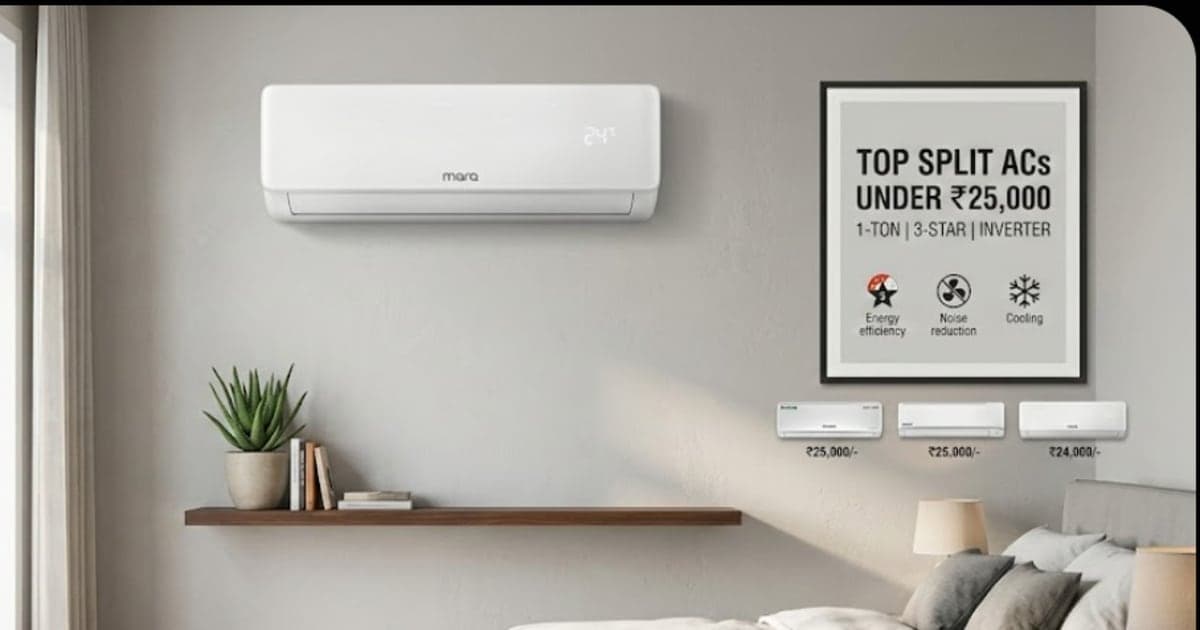
The good news is that ₹25,000 buys considerably more than it used to. Inverter compressors, copper coils, PM 2.5 filters — features that were firmly in the ₹35,000-plus territory three years ago have migrated down. The budget segment in 2026 is genuinely competitive, and the right pick here won't feel like a compromise six months from now.
Here's what's actually worth buying.
Quick Comparison
| Model | Type | Key Feature | Approx. Price |
|---|---|---|---|
| MarQ by Flipkart (2026) | 3-Star Inverter | Best value under ₹23k | ₹21,990 |
| Lloyd GLS12I3FWSEV | 3-Star Inverter | PM 2.5 filter + 52°C cooling | ₹24,990 |
| Panasonic CU-YU12WKYM | 3-Star Inverter | R32 refrigerant, built to last | ₹24,490 |
| Whirlpool Magicool DLX | 3-Star Fixed | Turbo cool, budget price | ₹22,500 |
| Onida IR123MJS | 3-Star Inverter | High ambient performance | ₹23,990 |
Before the Models: Get the Tonnage Right
One ton is the right call for a room between 100 and 120 square feet. That's most Indian bedrooms and small home offices.
People sometimes buy 1.5-ton units thinking bigger is better. It isn't. An oversized AC cools the room so quickly that it shuts off before it's had time to pull moisture from the air — leaving you with a space that is cold but clammy. A correctly sized 1-ton unit runs longer cycles, dehumidifies properly, and uses less electricity doing it.
Get the tonnage right first. Then look at everything else.
The Models
1. MarQ by Flipkart — 1-Ton 3-Star Inverter
This is the pick if your priority is spending as little as possible while still getting inverter technology and copper coils. [web:34]
MarQ is Flipkart's in-house brand, which means margins are kept tight and the savings come to the buyer. The 2026 model brings a 5-in-1 convertible mode — you dial down the cooling capacity when the room is half-occupied, which makes a real difference to your monthly bill. The copper condenser is non-negotiable for Indian climate conditions; aluminum corrodes faster and is expensive to fix once it does.
The trade-off is service. Flipkart's service network is thinner than Havells or Panasonic in Tier-2 cities. If you live somewhere that's well covered, it's excellent value. If you're in a smaller town, factor that in.
Best for: Students, bachelors, first-time AC buyers. [web:34]
2. Lloyd GLS12I3FWSEV — 1-Ton 3-Star Inverter
Lloyd is owned by Havells and has one of the better service networks in the country — which matters more than most buyers realise until something goes wrong two years in. [web:36]
The standout feature here is the PM 2.5 filter. If you're in Delhi, Lucknow, or any city where winter AQI is a public health event, having actual particulate filtration in your AC is not a gimmick — it's useful. The "Cool at 52°C" claim means the compressor holds performance during a heatwave rather than tripping out when ambient temperatures peak. Golden Fin coating on the evaporator handles the corrosion concern. [web:36]
This is the most feature-complete option at this price. It sits right at the ₹24,990 ceiling but earns it.
Best for: Buyers in dusty or high-pollution cities who want proper after-sales support. [web:34]
3. Panasonic CU-YU12WKYM — 1-Ton 3-Star Inverter
Panasonic doesn't make the flashiest ACs and doesn't try to. What they make are machines that run for a decade without drama. [web:35]
The specific reason to pick this model in 2026 is the R32 refrigerant. Older units still use R410A, which has a significantly higher Global Warming Potential. R32 runs more efficiently, costs less to recharge if needed, and is where the industry is heading regardless. Getting ahead of that curve at this price point is sensible. The airflow throw is also notably strong — useful if your room is long and narrow and the AC sits at one end. [web:34]
Best for: Buyers who want to install it once and not think about it for the next eight years. [web:34]
Three Things That Actually Matter
A lot of buying guides at this price point get distracted by Smart Wi-Fi and app connectivity. In budget models, these features are often the first thing to stop working properly. Ignore them. Focus on these instead:
Inverter vs Fixed Speed
Fixed-speed compressors are cheaper upfront. They run at full power, hit the target temperature, shut off, and repeat — hard cycling that wears components faster and spikes your electricity bill. Inverter compressors modulate their speed, run more quietly, and typically save 20–30% on power costs compared to fixed-speed equivalents. In this price bracket, inverter models exist and are worth prioritising. [web:30]
Copper vs Aluminium Condenser
Aluminium condensers are cheaper to manufacture. They are also significantly harder to repair once they develop a leak — in most cases, you're looking at condenser replacement rather than a quick fix. Copper transfers heat more efficiently, handles India's humidity better, and is serviceable at any decent AC repair shop. Don't compromise on this regardless of what else you're sacrificing. [web:36]
The Star Rating and ISEER
The Bureau of Energy Efficiency's star ratings are based on the ISEER — Indian Seasonal Energy Efficiency Ratio. The formula is:
[\text{ISEER} = \frac{\text{Total Annual Heat Removed (kWh)}}{\text{Total Annual Energy Consumed (kWh)}}]
A 3-star ISEER typically sits between 3.5 and 4.0. A 5-star unit sits above 5.0. The electricity savings are real — but the price gap between 3-star and 5-star at 1-ton capacity is usually ₹7,000–₹9,000. At average Indian usage of 8 hours per day, that gap takes roughly 3–4 summer seasons to recover through lower bills. [web:30]
For heavy daily use, 5-star pays off eventually. For a bedroom AC running 6–7 months a year, 3-star is the smarter financial call.
The Costs Nobody Tells You About Upfront
Your ₹25,000 is not the final number. Plan for these:
Installation: ₹1,200–₹1,500 for standard fitting. This covers mounting the indoor unit, running pipes through the wall, and commissioning the gas charge. [web:30]
Copper pipe extension: Most brands include 3 metres of copper pipe in the box. If your outdoor unit needs to go further — common in apartments where the compressor terrace is on a different wall — budget ₹300–₹500 per additional metre.
Stabilizer: Modern inverter ACs print "stabilizer-free operation" in their spec sheets, which is technically true in stable grid conditions. In areas with frequent voltage fluctuations — most of Tier-2 and Tier-3 India at peak summer load — a dedicated AC stabilizer costs around ₹1,500–₹2,000 and protects a PCB that costs ₹4,000–₹7,000 to replace. The math is straightforward.
Running It Right
Clean the filters yourself, every two weeks during summer. Pop the front panel, slide out the filters, wash them under a tap. Takes five minutes. A clogged filter forces the blower to work harder, raises power consumption by 15–20%, and accelerates wear on the fan motor. Service engineers will charge you for this. There's no reason to pay them. [web:30]
Put the outdoor unit in shade if you can. A compressor working in direct afternoon sun in May is fighting the ambient heat before it's even started on your room. A shaded outdoor unit runs cooler, lasts longer, and uses less electricity. Even a simple corrugated sheet shade makes a difference.
Set it to 24°C, not 18°C. Setting the thermostat to 18°C doesn't cool the room faster — the AC can only remove heat at the rate its compressor allows, regardless of what you've set the target to. What 18°C does is make the compressor run continuously until it hits a temperature it can't reach, which is harder on the unit and more expensive to run. The Bureau of Energy Efficiency recommends 24°C as the optimal balance. Most people sleeping under a blanket at 24°C are more comfortable than they realise. [web:30]
The Call
₹25,000 is a real budget now. Three years ago it bought a fixed-speed AC with an aluminium coil and no filtration. In 2026 it buys a copper-coil inverter with a PM 2.5 filter and a service network behind it.
For a small room, these machines are more than capable. Pick the Lloyd if service network and air quality features matter most. Pick the MarQ if you want to spend less and your city has decent Flipkart service coverage. Pick the Panasonic if you want to forget the AC exists for a decade. [web:34][web:36]
Any of the three will see you through a brutal Indian summer without the electricity bill becoming its own emergency.
Prices sourced from live listings as of late February 2026. Online prices fluctuate — check current rates before purchasing.