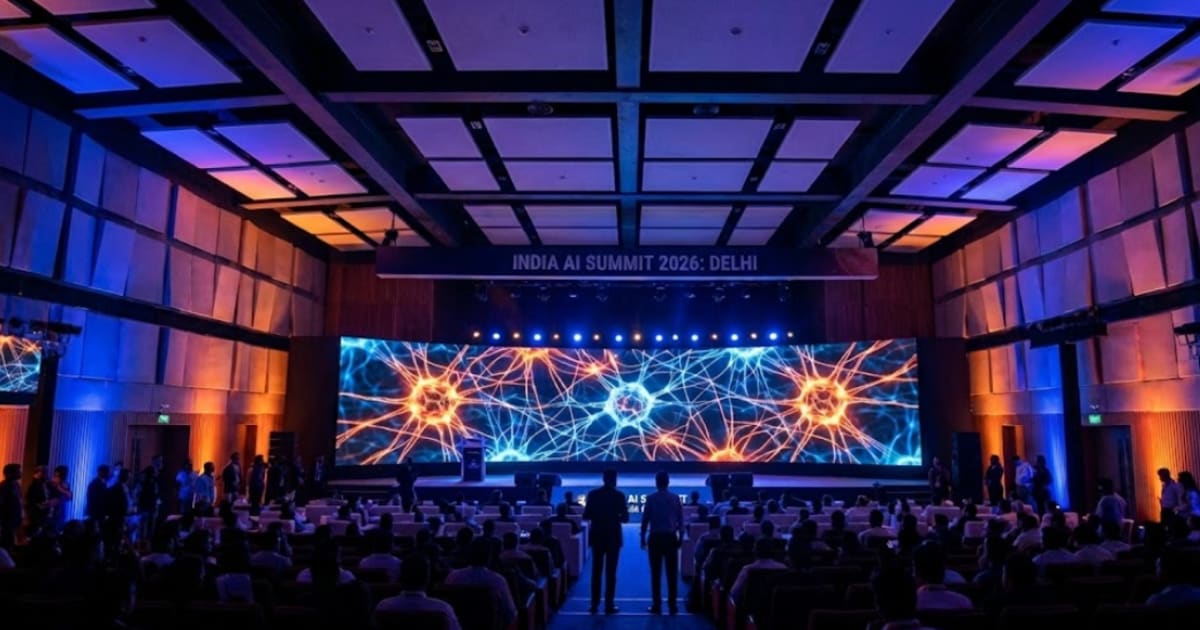
The AI Catalyst: Inside Today's India AI Impact Summit and the Future of Digital India
The Summit That Swallowed Every Conversation
Something is different about today. Open any trending feed across India and the usual suspects — market swings, political noise, last night's match — have been quietly elbowed aside. The India AI Impact Summit at Bharat Mandapam in New Delhi has swallowed the conversation whole, and it doesn't look like letting go anytime soon.
Getting there, apparently, was half the battle. The VIP convoy situation around the venue turned into something of a logistical nightmare — traffic locked up so badly that several attendees eventually abandoned their cars and walked the remaining kilometres on foot. A fitting metaphor, maybe, for how badly people wanted to be in that room.
Once inside, the energy justified every step. Industry heavyweights, policymakers, founders — the kind of gathering that usually only happens in Davos had landed in the heart of New Delhi. Rishi Sunak got genuine laughs with a remark about AI pressure being nothing compared to "family dinners with the Murthys." But the moment everyone will remember came from Prime Minister Narendra Modi, calm and unambiguous.
"AI will create jobs, not kill them."
What's Actually Happening to Developers
The doom narrative — AI swooping in and gutting the tech workforce — has been looking shaky for a while. Today might be the day it fully collapses.
Big Tech has quietly poured around $80 billion into India's technology infrastructure over recent months. Companies preparing to replace their developers don't write cheques like that.
What is changing is the nature of the work. The repetitive stuff — boilerplate code, standard test classes, the debugging that used to eat up entire afternoons — AI handles much of that now. But most developers aren't mourning it. That time is being redirected toward problems that actually require human judgment.
- Designing how systems talk to each other
- Anticipating security gaps before they become disasters
- Making legacy systems and new AI layers coexist without everything falling apart
Someone who has spent years going deep on a CRM platform or a specific backend architecture is sitting in a very interesting position right now. The market doesn't want faster code — it wants smarter architecture decisions, and those still need human expertise at the wheel.
The developer who combines real domain knowledge with sharp AI-assisted delivery is finding the work has never been easier to win.
A Solo Creator With Studio Output
Outside the enterprise world, something equally significant is unfolding — just a little more quietly.
Three years ago, producing genuinely polished animation meant a full team, serious software budgets, and months you couldn't always afford. A solo creator working in a niche subject area — say, Indian mythology or historical epics — could have a brilliant idea and almost no practical way to execute it at a quality level audiences would stick around for.
That particular wall has come down completely.
Google's own "Year in Search" data put Gemini as the second most searched term across India last year. That's not a statistic about tech enthusiasts in Bengaluru. That's a nationwide behavioural shift.
YouTube channels dedicated to India's rich cultural and religious heritage are where this is playing out most visibly. A creator who genuinely understands their subject — the iconography, the narrative arcs, the emotional resonance — can now use generative tools to bring that vision to life at a quality that was previously out of reach.
The craft has shifted from grinding through production mechanics to the higher-order work of storytelling, prompting, refining, and growing an audience. Most creators, given the choice, will take that trade every single time.
Building for India, Not Just Selling to It
Buried beneath the headline announcements is arguably the most consequential theme of the day — the industry is finally acknowledging that technology designed with India in mind will always outperform technology merely deployed here.
Acting on it — actually restructuring products around Indian sensibilities rather than just translating them — is something the industry has historically been slow to do. Now it's moving.
- Conversational AI that doesn't feel like a Western chatbot struggling with cultural context
- Subscription tiers priced for **students, freelancers, and small creators** — not just enterprise teams
- Interfaces that feel intuitive to someone working in **Bhopal or Patna**, not just in Palo Alto
The result is a quieter but meaningful shift in power. For years, using these tools meant bending your workflow to fit their assumptions. That dynamic is reversing.
The developer asking a question in a relaxed, conversational way and getting a genuinely useful answer. The creator generating imagery that reflects a specific regional aesthetic without having to fight the tool for it.
The Co-Pilot Era Is Here
The anxiety that defined the early AI conversation — will this take my job, make my skills irrelevant, render my years of experience worthless — is giving way to something more honest and, frankly, more exciting.
- Developers building things that would have taken **twice the team** two years ago
- Creators producing work that would have required a **full studio** eighteen months back
- Neither group replaced — both working at a level they couldn't have reached alone
That's the real story out of New Delhi today. Not the investment figures, not the keynotes, not even the traffic chaos.
India isn't just participating in this wave. It's one of the people deciding where it goes.
Covering technology news and trending stories from India. Follow @TrnIND