Not long ago, buying an IPL team was something film stars and industrialists did. It was glamorous, it was loud, and if you squinted at the balance sheets, it was at least partially a vanity project.
That era is over.
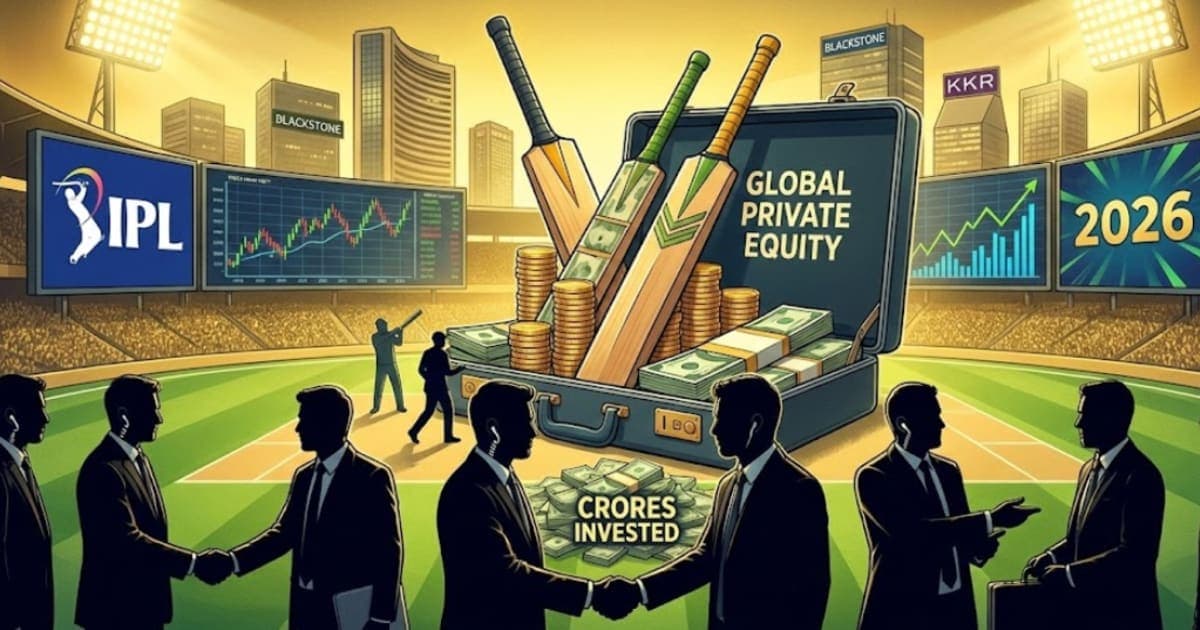
Walk into any IPL ownership conversation in 2026 and the names you're hearing aren't from Bollywood or even Indian industry anymore. Blackstone. Carlyle. Partners Group. KKR — the investment firm, not the Kolkata franchise, though the naming coincidence does cause some confusion in boardrooms. These are firms that manage hundreds of billions of dollars globally, firms that don't do vanity projects, firms that put capital somewhere only when the numbers make a very specific kind of sense.
The IPL now makes that kind of sense. Here's why.
CVC Did It First — And Made 350% in Four Years
Before anyone else had fully processed the idea of institutional money in Indian cricket, CVC Capital Partners — a European buyout firm — walked in and bought the Ahmedabad franchise for roughly $612 million in 2021. At the time, plenty of people thought they'd overpaid for a team in a city that had no IPL history and no existing fanbase.
Four years later, CVC sold a 67% majority stake to India's Torrent Group at a valuation of approximately $900 million. The return? Over 350% in dollar terms. In four years. From a cricket team.
That transaction changed the conversation in private equity circles globally. It wasn't just a good trade — it was proof of concept. It told institutional investors something they needed to see with real numbers before they'd believe it: that an IPL franchise wasn't just a trophy, it was a compounding asset. And once CVC walked out with that exit, every major PE firm on the planet started paying much closer attention to what was happening in Indian cricket.
The Business Model Is Unusually Investor-Friendly
Private equity has one primary love language: predictable cash flow. And the IPL's financial architecture is built in a way that almost seems designed to appeal to institutional investors.
Start with the structure. The IPL runs a closed-franchise system — no relegation, no promotion, no risk of a bad season destroying your asset value the way it can in European football. Your franchise exists regardless of where you finish. That alone removes a category of risk that makes football clubs significantly harder to underwrite.
Then there's the money that flows before you've done anything at all.
In 2022, the BCCI sold the IPL's broadcast and digital rights for the 2023–2027 cycle for $6.2 billion. The BCCI keeps half and distributes the rest equally across the ten franchises. That works out to roughly $55 million per franchise per year — guaranteed, before a single ticket is sold, before a single jersey leaves a warehouse, before a single local sponsor signs a check.
On a per-match basis, the IPL is now the second-most valuable sports league in the world, behind only the NFL. The NFL has 32 teams. The IPL has 10. That scarcity is not a footnote — it's the entire investment thesis. Ten assets. One billion potential consumers. No new supply coming.
RCB and Rajasthan Royals Are Both on the Market
The timing of all this institutional interest has landed right as two of the IPL's most recognizable franchises are exploring ownership changes ahead of the 2026 season.
Royal Challengers Bengaluru — the 2025 defending champions, owned by Diageo's United Spirits — are reportedly in sale discussions, with valuations being floated somewhere between $1.5 billion and $2 billion. Blackstone and KKR are both said to be evaluating stakes. RCB has one of the largest and most emotionally invested fanbases in the league — the kind of brand recognition that doesn't show up cleanly in a DCF model but absolutely shows up in merchandise revenue, digital engagement, and stadium atmosphere.
Rajasthan Royals — majority-owned by Emerging Media Ventures, with RedBird Capital Partners holding a minority position — are also advancing through a sale process. Bids are reportedly coming in between $1.1 billion and $1.4 billion.
Two franchises. Combined potential transaction value north of $3 billion. Both processes happening simultaneously. The IPL M&A market has never looked like this before.
It's Not Just a Team — It's a Conglomerate
Here's the part of the IPL investment story that doesn't get written about enough.
A two-month tournament has an obvious ceiling on how much revenue it can generate in isolation. Smart IPL owners figured this out years ago and started buying sister franchises in other T20 leagues — SA20 in South Africa, Major League Cricket in the United States, ILT20 in the UAE, the CPL in the Caribbean. The same players, the same brand infrastructure, the same sponsor relationships — stretched across four or five leagues running at different points of the calendar.
When a PE firm buys an IPL franchise in 2026, they're not buying a team that plays for two months. They're buying the anchor asset in a multi-league, multi-continent cricket operation that runs year-round. Player contracts get leveraged across leagues. Fan databases span different time zones. A jersey sponsor can get visibility in Johannesburg in January, Dubai in February, and Mumbai in April.
That's not a cricket club. That's an alternative asset with a global content engine attached to it.
The One Risk Nobody's Ignoring
It would be dishonest to write about this without mentioning the thing that's genuinely keeping some investors cautious.
The current media rights deal — the $6.2 billion one — runs through 2027. The next auction is coming, and the landscape for that bidding process looks different from 2022. The Disney-Reliance merger that created JioStar has reduced the number of serious competing bidders. Less competition in a rights auction generally means lower final numbers. If the 2027 deal comes in meaningfully below the 2022 benchmark, the guaranteed annual income flowing to franchises gets compressed — and that changes the valuation math.
Nobody is panicking about this yet. The IPL's viewership numbers — 1.19 billion viewers across digital and TV last season — are too large to ignore, and there will always be someone willing to pay for that scale of audience. But it's a variable worth watching, and institutional investors are watching it.
What's Actually Happening Here
The simplest way to describe it: the IPL has completed its transition from a sports entertainment product into a mature alternative asset class. The celebrity owners didn't disappear — some of them are still around. But the centre of gravity in IPL ownership has shifted, quietly and then very quickly, toward institutional capital that sees Indian cricket the same way it sees infrastructure or real estate — as a long-duration, high-return asset tied to one of the fastest-growing consumer economies in the world.
CVC saw it in 2021. Made 350% and walked out.
Now everyone else is trying to get in before the door closes.
This article is for informational and educational purposes only and does not constitute financial or investment advice. Valuation figures cited are based on publicly reported estimates and industry sources as of February 2026.