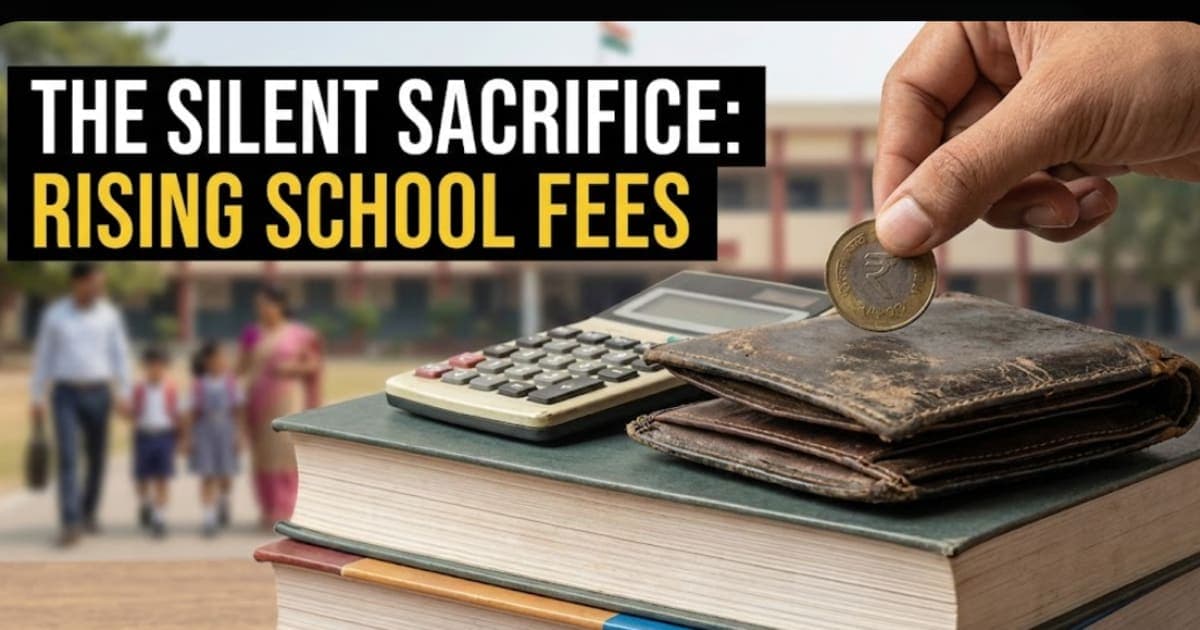
The Silent Sacrifice: How a Noida Doctor's Viral Post
Ignited India's Debate on Surging School Fees
There's a moment most urban Indian parents know intimately but almost never talk about.
The school fee notice arrives — email, app notification, sometimes still a printed slip in the school diary. You open it. The number is higher than last year. It's always higher than last year. You close the notification, do a quiet calculation in your head, and figure out what to move around this month to make it work. You don't call the school. You don't post about it. You just absorb it and adjust.
Dr. Shraddhey Katiyar, a doctor based in Noida, posted about it. And the response told you everything about how many people had been waiting for someone to say it out loud.
"They Test Their Silence"
His post wasn't a data dump or a policy argument. It was something quieter and, because of that, considerably more devastating.
"School fees don't just test a parent's income. They test their silence."
That line alone did most of the work. What followed was an account of something most parents in India's cities recognize instantly — the way a fee hike doesn't announce itself as a crisis, it just quietly rearranges things. The vacation that gets postponed. The home repair that waits another year. The retirement contribution that takes a pause that stretches longer than intended. Extra shifts taken on without explanation to anyone who asks.
"Every year, the number rises. And parents quietly adjust life around it," he wrote. "Fewer vacations. Delayed dreams. Extra shifts. No complaints. Just quiet sacrifice."
Thousands of people replied within hours. Not with anger, exactly — with recognition. The kind of recognition you feel when someone finally articulates something you've been carrying alone.
What Parents Are Actually Paying For
The debate that erupted in the replies exposed a disconnect that a lot of people have felt but struggled to frame precisely.
Every fee hike comes with language. Infrastructure upgrades. Quality enhancement. Improved learning outcomes. The communication from the school is always confident and always vague in the same specific ways — big words, no line items, no accountability for where last year's increase went.
And then you actually look at the classroom.
Overcrowded. Student-to-teacher ratios that nobody at the school talks about publicly. Teachers who are, by any honest accounting, severely underpaid for the work being asked of them. The money is clearly going somewhere. It is visibly not going to the people standing in front of your child every day.
"We are told it's for quality education," Dr. Katiyar noted. "But classrooms stay crowded, and teachers stay underpaid. A child's future should not feel like a monthly threat."
The replies built a picture. Parents describing schools that look like five-star hotels from the outside — manicured campuses, elaborate annual day productions, glossy brochures — while the actual educational infrastructure inside tells a different story. The Instagram-friendly facade and the reality of what's happening in the classrooms are two different institutions sharing the same address.
The Hidden Invoice
Tuition is the number on the headline. It's rarely the actual number.
The comment threads under Dr. Katiyar's post became something close to a collective accounting exercise. Parents listing, in detail, everything that sits underneath the tuition line.
Non-refundable admission fees that, for nursery admissions in certain cities, run into lakhs. Mandatory uniforms that can only be purchased from the school's designated vendor at prices that bear no relationship to the market rate. Books, same deal. Technology fees that appear annually without explanation of what technology they're funding. "Development charges" that exist primarily to stay outside the scope of any fee regulation that might apply to tuition. Color day contributions. Compulsory photo books. The school trip that isn't quite compulsory but your child is the only one not going if you say no.
"The schools have become like a cartel," one user wrote. "All of them simply hike fees every year without any justification."
The cartel framing resonates because the experience it describes is real. In most Indian cities, the private schools that families consider viable options for their children tend to move on fees together — not through explicit coordination, but through a market dynamic that produces the same outcome. There is no competitive pressure to hold fees down. The parents have nowhere else to go.
What This Is Doing to Family Planning
This is the part of the conversation that nobody was fully prepared for, and it surfaced organically in the replies rather than through any deliberate framing.
People started talking about having children.
Or deciding not to.
"Seeing the fees and fee hike every year, one is bound to feel — why have kids? And if it is necessary, have one. Two kids is a luxury nowadays."
That comment received thousands of likes. It wasn't an outlier. It was a thread of its own.
The calculation that young urban couples are making in India right now — about whether they can afford to educate a child at the standard they feel is expected of them, by their families, by their peers, by the society they live in — is one of the more consequential quiet calculations happening in the country. The fee inflation isn't just a monthly financial stress. It is actively reshaping decisions about whether to have children at all.
When the cost of a basic necessity gets priced at luxury levels, it changes behavior in ways that extend far beyond household budgets.
Why Nobody Was Saying This Before
Dr. Katiyar named it directly: silence.
In Indian middle-class culture, providing for your child is not separable from your identity as a parent. To complain about school fees — publicly, visibly, by name — is to invite a question you don't want asked: can you actually afford this?
The stigma is real and it runs deep. Parents who push back against fee hikes worry, not entirely without basis, about what that means for their child inside the institution. The power dynamic is completely asymmetrical. The school holds something you cannot easily replace — your child's enrollment, their friendships, their continuity, the years already invested in a particular educational environment. Complaining risks all of that.
So you don't complain. You absorb it. You adjust. You stay silent.
What Dr. Katiyar's post did was create a space where the silence broke, briefly, and enough people responded to make everyone realize they had been suffering the same thing in the same isolation.
Where This Goes Now
He ended his thread with something that has been shared more than almost anything else in the post:
"Education was meant to uplift families, not exhaust them. And the heaviest lesson children learn is this: their parents paid the price, silently."
The viral moment has done what viral moments do — it has made something private into something public. Whether that translates into actual change depends on things that a social media thread cannot deliver. Fee regulation acts exist in several states. Enforcement is another matter. Schools have proven consistently inventive at rerouting charges through categories that regulation doesn't quite reach.
What has changed, at minimum, is the willingness to say it. The parents who absorbed this year's fee hike in silence will absorb next year's too, probably. But they're talking about it now. In comment sections, in WhatsApp groups, in conversations that weren't happening at this volume before.
A Noida doctor said what he saw. Millions of people said: yes, that's exactly it.
That's not nothing. It's not enough. But it's not nothing.
This article is a cultural and social commentary piece based on the publicly shared social media thread by Dr. Shraddhey Katiyar and publicly available responses from Indian social media users as of February 2026. All quotes from the thread are reproduced as reported in publicly accessible posts.