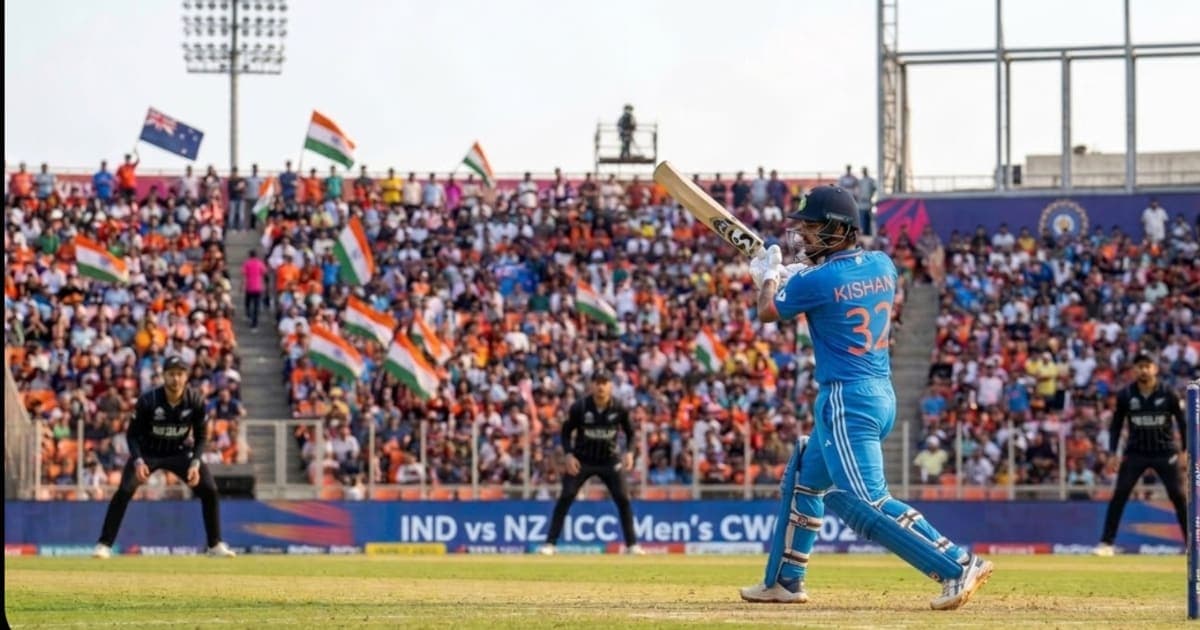
Ishan Kishan's 54 Off 25 Balls: The Finisher Who Turned a Big Total Into a Record One
AHMEDABAD, March 8, 2026 — Abhishek Sharma had set the table. Sanju Samson had laid out the feast. Then Ishan Kishan walked in and ate everything that was left.
54 runs. 25 balls. 4 fours. 4 sixes. A strike rate of 216. In the T20 World Cup 2026 Final against New Zealand, the Jharkhand southpaw delivered the kind of cameo that doesn't just win matches — it wins tournaments, breaks records, and sends 132,000 people home with a story they'll tell for the rest of their lives.
The Moment He Walked In
When Abhishek fell for 52 in the eighth over, India were 110 for 1 and already in dominant territory. The risk at that point — the one thing that could have derailed what was shaping up to be a historic innings — was a middle-order collapse. One big wicket, two quick ones, and suddenly the fielding restrictions are gone and New Zealand are back in the contest.
Ishan Kishan didn't let that happen.
He walked to the crease, assessed the field for exactly one delivery, and then decided he'd seen enough.
The second ball he faced — a length delivery from Matt Henry angled across him — he flicked off his pads, inside-out, straight over long on. Six. Not a slog. Not a heave. A deliberate, wristy, technically correct shot that happened to travel 85 metres.
The Narendra Modi Stadium, still buzzing from Abhishek's departure, went straight back to deafening.
What his innings looked like:
- 54 runs off 25 balls
- Strike rate: 216.00
- 4 fours — all in the arc between covers and midwicket, laser-guided
- 4 sixes — wide mid-on, long on twice, and one extraordinary ramp over fine leg off a Lockie Ferguson bouncer
- Dismissed in the 17th over caught at long off — India were 241 for 3 at that point
The Partnership That Killed the Contest
The Samson-Kishan stand, from the ninth over through to the 17th, added 131 runs off 51 balls. That number deserves to be read slowly. 131 runs. 51 balls. In a World Cup final. Against a bowling attack that had beaten South Africa in the semi-finals three days earlier.
The two of them divided their roles instinctively — Samson playing the accumulator role relative to Kishan, which is a sentence that would have seemed absurd if Samson himself hadn't been scoring at 193. But Kishan was operating at a different frequency entirely, targeting the shorter boundaries on the leg side and the straight boundaries over the bowler's head with a consistency that made New Zealand's field placings feel largely irrelevant.
Tim Southee tried five different field placements across one over against Kishan. None of them worked. Kishan hit the gaps that appeared, hit over the ones that didn't, and finished the over with 18 runs from it.
Lockie Ferguson, New Zealand's most dangerous bowler, was the one who finally ended the partnership — dismissing Kishan with a sharp short ball that the left-hander top-edged to long off. But by that point the damage was done, and the damage was historic.
Ishan Kishan's Tournament Arc
This innings means something beyond the final.
Kishan came into this World Cup squad with questions about his place. His form in bilateral cricket over the preceding months had been inconsistent — some explosive performances sandwiched around disappearing acts that had selectors wondering whether his spot in a 15-man World Cup squad was the right call.
Through the group stages, he batted in the middle order without registering a significant score — two 20s and a 34 not out, useful but not the kind of innings that settles the debate. In the semi-final against England he came in with India already in a commanding position and added a quick 28 not out that accelerated the chase of a revised target.
Tonight was different. Tonight he came in during an innings that was big but not yet historic, and left it in a state that could only be described as record-threatening.
That is what T20 finishers at the elite level are supposed to do. Kishan did it on the grandest stage the format offers.
The Number He Was Chasing — and Surpassed
India's total, when it was finally complete, placed them in a territory that will require fact-checking from the record books. The total built on Abhishek's 52, Samson's 89, and Kishan's 54 — three separate explosions from three different batters at three different stages of the innings — created something that New Zealand's bowlers had no answer for and no blueprint to handle.
Kishan's 25-ball fifty, in the context of where India were and where they needed to go, was arguably the most impactful innings of the three. Abhishek set the tone. Samson sustained it. Kishan detonated it.
The distinction matters because of timing. A 25-ball fifty in overs 9 through 17 of a T20 World Cup final — when fields have spread, when bowlers are looking for dot balls, when the defensive option is always available — requires a particular kind of fearlessness that is rare even at international level.
Kishan played it like it was a bilateral series against Zimbabwe. That, in the most complimentary possible way, is exactly what India needed.
What Comes Next
New Zealand need to bat. The total they're chasing is a number that statistics suggest has never been successfully chased in a T20 World Cup knockout match.
Finn Allen will need to be extraordinary in the powerplay. Kane Williamson will need to anchor an innings that can't afford an anchor. Every New Zealand batter will need to perform at or beyond the peak of their ability — simultaneously, consistently, for 20 overs — against Jasprit Bumrah, Hardik Pandya, and an Indian bowling attack that knows exactly what it's defending.
They are not impossible. But they are facing a total built by three different batters playing three of the most destructive World Cup final innings in the history of the format.
Abhishek gave India the launchpad. Samson gave them the altitude. Ishan Kishan gave them the escape velocity.
54 off 25. Four fours. Four sixes.
The scoreboard doesn't lie.