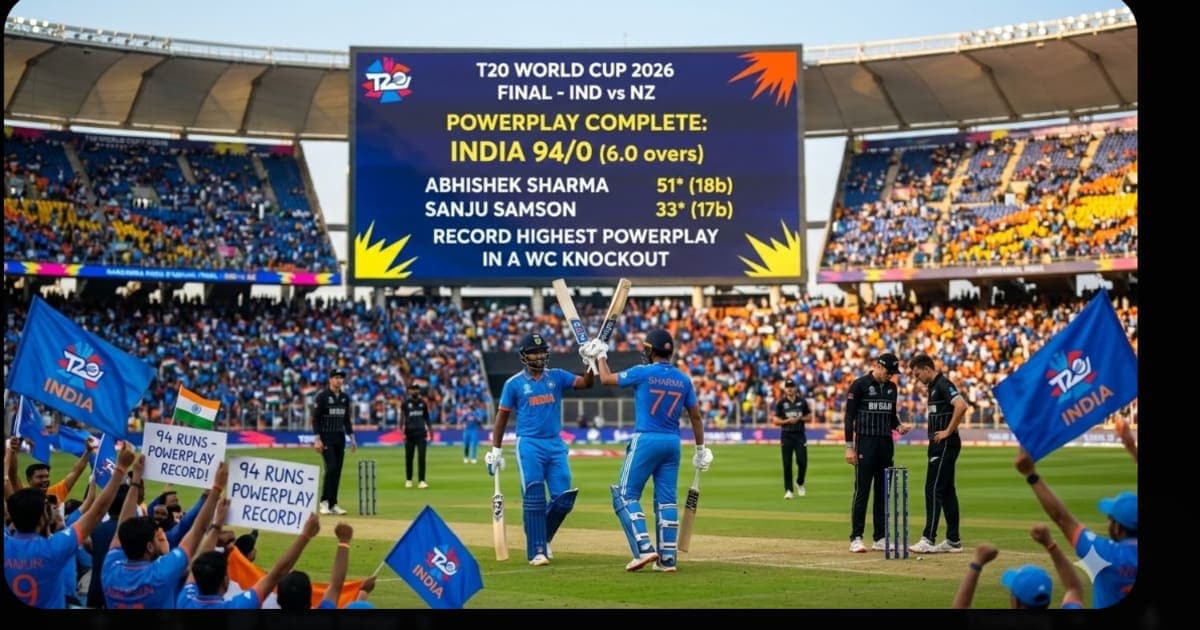
India's Powerplay in the T20 World Cup Final: 6 Overs, 94 Runs, Zero Wickets — History Rewritten
AHMEDABAD, March 8, 2026 — Six overs. 94 runs. No wickets. The New Zealand bowling attack walked off the field at the end of the powerplay looking like men who had just been in a car accident and were still trying to figure out what had happened.
India's powerplay in the T20 World Cup 2026 Final against New Zealand at the Narendra Modi Stadium wasn't just a good start. It was the most devastating six-over opening in World Cup final history — a collective assault from Abhishek Sharma and Sanju Samson that rendered New Zealand's entire bowling strategy redundant before most of the crowd had finished their first snack.
For context: India's previous best powerplay in a T20 World Cup knockout match was 72. Tonight they beat that by 22 runs. Without losing a wicket.
Over by Over — How It Happened
Over 1 — Matt Henry (7 runs) Henry opened the attack with discipline — three dots to Abhishek, then Samson launched the fourth ball straight over long on for six. Two dots followed. 7 off the first over, one boundary, the crowd beginning to hum. On paper, a controlled opening. In reality, the last controlled over New Zealand would bowl for a long time.
Over 2 — Jacob Duffy (23 runs) This is where the final changed.
Abhishek Sharma decided, somewhere between the first and second over, that he was done watching. Duffy's first delivery — a length ball angling in — was driven through the covers for four. The second, slightly shorter, was pulled to the midwicket fence. Four again. Then a six, high and straight, that disappeared into the Ahmedabad night sky and brought 132,000 people to their feet at the same moment.
Samson finished the over with a boundary of his own through point. 23 runs off the over. 30 for 0 after two. New Zealand's powerplay plan was already in pieces.
Over 3 — Lockie Ferguson (14 runs) Ferguson — New Zealand's best and most experienced powerplay bowler — tried pace and bounce. Abhishek rode the bounce and cut him through point for four. Samson, at the other end, picked up a six over square leg off a short ball that wasn't short enough. A couple of dots restored some respect for the scoreboard, but only barely. 14 off the over. 44 for 0 after three.
Over 4 — Glenn Phillips (leg spin) (18 runs) Captain Suryakumar Yadav's most aggressive tactical choice of the innings — bringing on Glenn Phillips' leg-spin in the fourth over of a World Cup final. A high-risk move designed to break the partnership and introduce uncertainty.
It didn't work.
Abhishek read the leg-spin immediately, stepping down the wicket twice and sending two deliveries over long on in the same over. Samson picked the googly, nudged it through midwicket for four, then hit the next one — a full toss that Phillips would want back — straight down the ground for six.
18 runs off the over. 62 for 0 after four. Glenn Phillips did not bowl again.
Over 5 — Matt Henry (second spell) (16 runs) Henry came back, trying to stem the flow with a fuller length targeting the stumps. Samson hit him for back-to-back fours through the off side — drives so clean they barely needed to move the field for them to reach the boundary. Abhishek added a six over wide long on off the fifth ball. 16 off the over. 78 for 0 after five.
Over 6 — Jacob Duffy (second spell) (16 runs) Duffy's second over was as bad as his first. Abhishek — now in complete control, picking length from the hand and deciding his shot before delivery — pulled a short ball over square leg for six, his third maximum of the powerplay. Samson drove two boundaries through the off side, barely breaking sweat. 16 off the over.
End of powerplay: India 94 for 0
Abhishek Sharma: 51 off 19 balls Sanju Samson: 39 off 24 balls
What Made New Zealand's Bowlers Look So Helpless
It wasn't one thing. It was everything, simultaneously.
The pace plan failed immediately. Henry and Ferguson are two of the best pace operators in T20 cricket. Both bowl with movement, both have variations, and both were hit for sixes inside the first three overs. When your best pacers can't tie down a Test-quality batter in the opening powerplay, there is no plan B that fixes it.
The spin gamble backfired. Bringing Phillips on in the fourth over was a calculated risk that made logical sense — two left-handers at the crease, leg-spin creating different angles, surprise in the middle of a powerplay. Abhishek Sharma has faced enough quality leg-spin over his IPL career to read it, and he read Phillips like a newspaper.
The partnership running between deliveries. India didn't just hit boundaries. They ran hard between wickets, converted ones into twos repeatedly, and never allowed a dot ball to apply actual pressure. The dot-ball count across six overs was just nine — out of 36 deliveries bowled. That ratio is extraordinary.
Both batters were in form simultaneously. This is rare. Usually in a T20 powerplay, one batter is dominant and the other plays second fiddle. Tonight both Abhishek and Samson were timing the ball from ball one. There was no weak link for New Zealand to target, no side to attack from.
The Numbers in Historical Context
| Powerplay Score | Match | Tournament |
|---|---|---|
| 94/0 | India vs New Zealand Final 2026 | T20 World Cup 2026 |
| 72/0 | India vs England Semi 2026 | T20 World Cup 2026 |
| 68/1 | India vs Pakistan 2024 | T20 World Cup 2024 |
| 59/1 | England vs India Final 2022 | T20 World Cup 2022 |
No T20 World Cup knockout match — semi-final or final — has ever seen a powerplay score of 94 without loss. The closest comparison in any ICC knockout is theoretical territory. India didn't just break the record. They broke it by a margin that makes the comparison uncomfortable.
What It Meant for the Rest of the Innings
When a team scores 94 in the powerplay without losing a wicket, two things happen to the opposition immediately.
The bowling captain runs out of ideas. Kane Williamson had used all four of his primary powerplay options — Henry, Duffy, Ferguson, and Phillips — by over six. The middle overs were suddenly about damage limitation rather than wicket-taking. That mental shift, from hunting for breakthroughs to preventing collapse, is the most demoralising thing that can happen to a fielding side.
The batting side enters the middle overs with zero pressure. India's batters in overs 7 through 15 — Abhishek for one more over before his dismissal, then Sanju Samson through to his 89, then Ishan Kishan's explosive 54 — played in an atmosphere of total freedom. When you're 94 for 0 at the end of six, you are not chasing a total. You are constructing one.
The final India posted is sitting in record territory. The New Zealand bowlers know exactly where it started — six overs, 94 runs, zero wickets, and a powerplay performance that will be referenced every time someone wants to describe what a great T20 opening partnership looks like.
India didn't just win the powerplay. They won the final in the first six overs.
Everything else has been detail.