India and Canada Are Back. Here's What $2.6 Billion in Uranium and a $50B Trade Target Actually Mean.
Two years ago, Justin Trudeau stood in the Canadian Parliament and accused the Indian government of involvement in the killing of a Canadian citizen on Canadian soil. India called it absurd. Diplomats were expelled. Trade talks froze. The relationship — already complicated, never simple — appeared to be in genuine, possibly lasting damage.
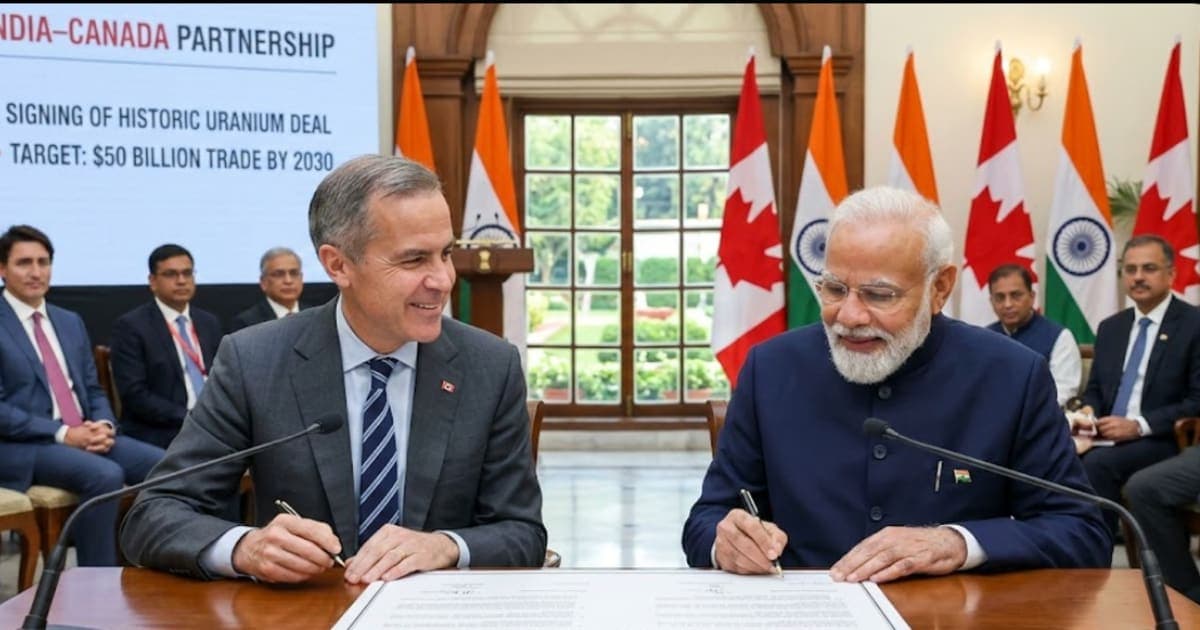
On Monday, Mark Carney sat across from Narendra Modi at Hyderabad House and signed a $2.6 billion uranium deal.
That is a significant distance to travel in a short time. How both governments got there, and what they are building now, is worth understanding properly — because this is not just a diplomatic photo opportunity. The numbers behind it are real, and the strategic logic on both sides is unusually clear.
What the Uranium Deal Actually Is
Saskatoon-based Cameco will supply nearly 22 million pounds of uranium to fuel India's civil nuclear reactor fleet under a long-term agreement anchored Monday. For context, India is in the middle of the most ambitious nuclear expansion programme of any democracy on earth — a target of 100 GW of nuclear power capacity by 2047, under the Viksit Bharat framework.
That requires uranium. A lot of it. Reliably, over decades, from a source that is geopolitically stable and not subject to the kind of sanctions or supply disruptions that complicate India's relationship with some of its other energy partners.
Canada is the second-largest uranium producer in the world. Cameco is its biggest mining company. The match is not complicated.
Modi framed it as the beginning of something larger: civil nuclear energy first, then Small Modular Reactors, then advanced nuclear technologies. Carney, the former central banker who understands long-term capital allocation in a way most politicians don't, framed it through resource security and clean-tech supply chains.
Both framings are accurate. They are also not in conflict, which is part of why the deal got done.
The $50 Billion Question
The uranium agreement is the headline. The $50 billion bilateral trade target by 2030 is the architecture around it.
Current bilateral trade sits well below that number. Getting to $50 billion in four years requires the Comprehensive Economic Partnership Agreement — the CEPA — to actually be concluded. Carney pledged to finalise it by the end of 2026. That deadline has been floating around for a while, under previous governments, without materialising. The difference now is that Canada has a more urgent reason to make it happen.
The United States is threatening a 25% tariff wall on Canadian goods. That is not a hypothetical — it is the trade environment Canada is currently navigating. The Indo-Pacific Strategy is, in part, Canada's answer to the question of what it does if its largest trading partner becomes significantly more expensive to trade with. India — 1.4 billion people, the fastest-growing major economy, already home to over $100 billion in Canadian pension fund investment — is the most obvious large-market alternative.
This is not charity. It is portfolio diversification at a national scale.
What Else Got Signed
The summit produced more than the uranium deal.
| Sector | Agreement |
|---|---|
| Bilateral Trade | $50 billion target by 2030 |
| Energy | $2.6B uranium deal + SMR collaboration |
| Critical Minerals | MoU for EV and semiconductor supply chains |
| Education | Canadian universities to open campuses in India |
| Investment | $100B+ in existing Canadian pension fund assets |
The critical minerals MoU is quieter than the uranium deal but arguably as consequential over time. The agreement integrates Canadian mining expertise — particularly in lithium — with India's manufacturing scale, targeting lithium-ion battery and semiconductor production. Both countries are trying to build supply chains that don't run through China. That is a shared interest with real commercial weight behind it.
The education agreement — Canadian universities establishing campuses in India — is notable for a different reason. Canada has one of the largest Indian diaspora communities in the world. Indian students are the largest source of international enrolment at Canadian universities. The relationship between the two countries at a people-to-people level has always been enormous, even when the government-to-government relationship was frozen. Formalising an institutional education presence in India is, among other things, an acknowledgement that the demographic and cultural ties were never going to disappear regardless of what happened in Parliament.
The Nijjar Question
It would be dishonest to write about this summit without being direct about what it is moving past.
The 2023 rupture was serious. Trudeau's allegations — that Indian government agents were involved in the killing of Hardeep Singh Nijjar in British Columbia — were not a minor diplomatic irritant. They were a direct accusation of state-sponsored murder on Canadian soil. India's response, categorical denial and the expulsion of Canadian diplomats, left the relationship with no obvious path to repair while Trudeau remained in office.
Carney is not Trudeau. His approach has been described as "constructive and balanced" by Indian officials, which in diplomatic language means: he is not going to hold press conferences about it. The two governments have established a National Security and Law Enforcement Work Plan — a mechanism for professional-level cooperation on transnational crime and extremism that keeps the security conversation happening at an institutional level rather than a political one.
The Nijjar case remains under judicial consideration in Canada. Neither government pretended on Monday that it doesn't exist. What they decided, implicitly, is that a $2.6 billion uranium deal and a $50 billion trade target and a critical minerals partnership and Canadian pension funds in Indian infrastructure — that the weight of all of that is not going to be held hostage to a case that the courts are handling.
Whether that is pragmatic statesmanship or a convenient shelving of accountability depends on where you stand. Both readings are circulating. The deal got signed regardless.
Why Carney Needed This as Much as Modi Did
It is worth being clear that the enthusiasm on the Canadian side is not purely altruistic or strategic in an abstract sense. It is urgent.
A potential 25% tariff wall from Washington is an existential trade problem for a country that sends the majority of its exports south. Canada has been looking for the Indo-Pacific pivot to be real rather than aspirational for years, and previous governments never quite closed the distance between the strategy documents and actual signed agreements.
Carney — an economist by training, a central banker by career, now a prime minister navigating a genuine trade emergency — came to New Delhi with more motivation to finalise things than any of his predecessors. The uranium deal, the CEPA timeline, the pension fund formalisation: these are not gifts to India. They are Canada building alternative infrastructure for its own economic survival in a world where the American trade relationship may be repriced dramatically.
Modi understood that dynamic and used it. The terms India got — long-term supply, technology collaboration, education access, no public re-litigation of 2023 — reflect the negotiating position of a country that knew it was being courted.
What "Reset" Actually Means Here
Carney said Monday: "This is not merely the renewal of a relationship. It is the expansion of a valued partnership with new ambition, focus, and foresight."
Strip out the diplomatic register and the sentence means: we are not pretending the last two years didn't happen, but we are also not going to let them define what comes next.
That is a reasonable position. Whether it holds depends on what the Canadian courts eventually conclude about the Nijjar case, and whether whatever they conclude can be absorbed by a relationship that will, by then, have $2.6 billion in uranium contracts and a CEPA framework sitting on top of it.
The architecture being built on Monday is designed, in part, to make that absorption possible. Whether the architecture is strong enough is something neither government knows yet.
All figures reflect information available at time of publication.