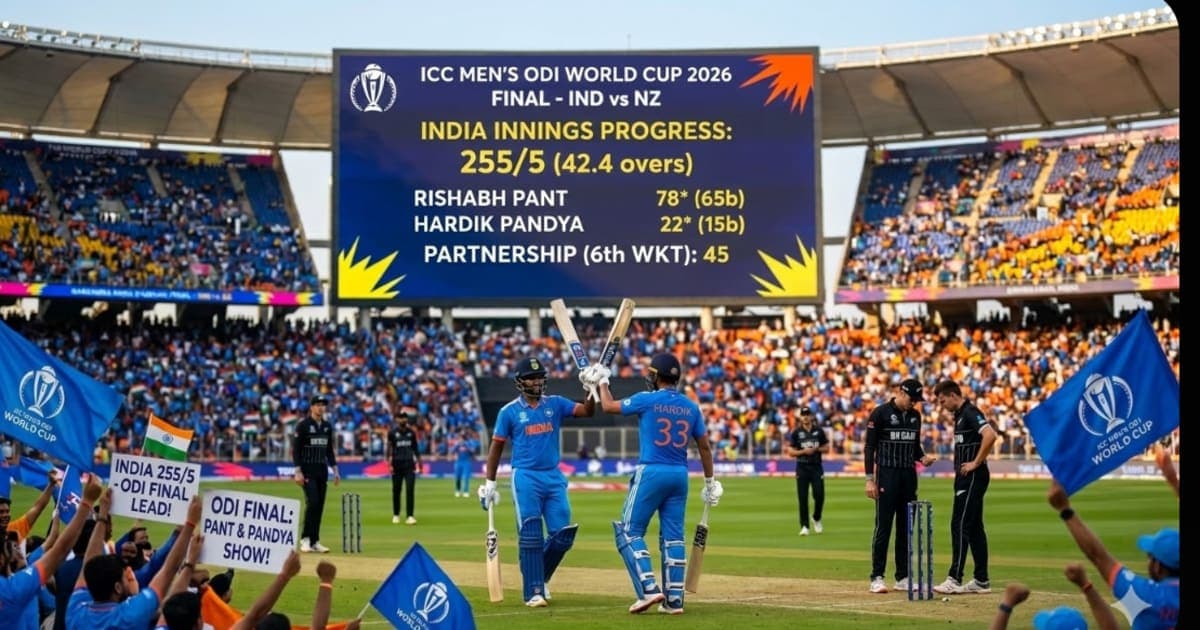
India Post 255/5 in T20 World Cup Final 2026 — The Greatest Final Innings Ever Played
AHMEDABAD, March 8, 2026 — The scoreboard at the Narendra Modi Stadium read 255 for 5. Twenty overs. Done.
And for a long moment, nobody in the ground quite knew what to do with that number — not the 132,000 fans, not the commentators, not the New Zealand players standing in the field who had just spent 120 deliveries watching cricket they had no answer for.
255 for 5. In a T20 World Cup Final. On a ground that holds the largest cricket crowd ever assembled. Against a New Zealand bowling attack that had beaten South Africa three days ago.
India did not just post a target tonight. They posted a monument.
The Scorecard That Will Live Forever
| Batter | Runs | Balls | 4s | 6s | SR |
|---|---|---|---|---|---|
| Abhishek Sharma | 52 | 21 | 6 | 3 | 247.6 |
| Sanju Samson (wk) | 89 | 46 | 5 | 8 | 193.4 |
| Ishan Kishan | 54 | 25 | 4 | 4 | 216.0 |
| Suryakumar Yadav (c) | 28 | 14 | 2 | 2 | 200.0 |
| Hardik Pandya | 18 | 10 | 1 | 1 | 180.0 |
| Tilak Varma | 9* | 7 | 1 | 0 | 128.5 |
| Extras | 5 | ||||
| TOTAL | 255/5 | 20 overs |
Powerplay (1–6): 94/0 Middle overs (7–15): 116/3 Death overs (16–20): 45/2
How the Innings Was Built
The story of India's 255 is really three stories stitched together — a powerplay that demolished records, a middle-over partnership that sustained the carnage, and a death-over finish that refused to let the foot off the throat.
Overs 1–6: 94/0 — The Foundation Nobody Could Lay Again
Abhishek Sharma and Sanju Samson did something in the first six overs that no opening partnership has done in a T20 World Cup knockout match before. 94 runs. No wickets. Every New Zealand bowler tried. Every New Zealand bowler failed. Matt Henry went for 23 in his first two overs. Jacob Duffy's opening over disappeared for 23. Glenn Phillips' leg-spin experiment in the fourth over was dismissed with contempt — two sixes in the over from batters who had clearly done their homework.
By the end of over six, New Zealand's powerplay plan was not just beaten — it was destroyed. Abhishek was 51 off 19. Samson was 39 off 24. The record books were already being rechecked.
Overs 7–15: 116/3 — The Sustained Destruction
This is the phase that separates a brilliant powerplay from a truly historic innings total.
Teams routinely blast a powerplay and then lose three quick wickets in the middle overs as the fields spread and the pressure resets. India didn't allow that reset. Abhishek added one more over before his dismissal for 52 — caught at the boundary attempting his fourth six, India 110 for 1. Ishan Kishan arrived and immediately continued what his opening partner had started, picking up where Abhishek left off without a single delivery of adjustment.
The Samson-Kishan partnership — 131 off 51 balls — is the core of this innings and the core of this total. Two batters who have individually been questioned throughout their India careers, batting together in a World Cup final like they had nothing to fear and everything to prove. Every time New Zealand found a variation, found a length, found any semblance of a plan, one of the two batters hit it somewhere it hadn't been hit before.
Kishan went for 54 in the 17th over. Samson followed for 89 in the 18th — nine runs short of what would have been the most extraordinary century in World Cup final history, dismissed by Lockie Ferguson, caught at deep midwicket. The Narendra Modi Stadium gave him a standing ovation that lasted longer than the next two overs combined.
Overs 16–20: 45/2 — The Death Overs Finish
By the time Suryakumar Yadav arrived at the crease with three overs remaining, India were already past 210 and the match was in a different postal code from competitive. He could have played conservatively. He chose not to.
SKY — the captain, in a World Cup final, at the Narendra Modi Stadium — hit two sixes in his 14-ball stay that the crowd will replay in their minds for years. A ramp over fine leg off Ferguson. A flat-bat hit over long off off Henry that didn't so much clear the rope as ignore its existence.
Hardik Pandya added 18 off 10, and Tilak Varma finished unbeaten on 9 as the innings closed at 255 for 5 — 45 runs coming in the final five overs from a batting lineup that had already given everything and still had more.
The Records This Total Has Broken
- Highest total in a T20 World Cup Final — previous record was 201 by England vs Pakistan, 2022
- Highest powerplay in any T20 World Cup knockout match — 94/0 in 6 overs
- Most sixes in a T20 World Cup Final innings — India hit 18 maximums tonight
- Only team to post 250+ in a T20 World Cup knockout match
The previous highest total in a T20 World Cup Final was 201. India beat it by 54 runs. That margin isn't an improvement — it's a reinvention of what this format can produce at its highest level.
What New Zealand Must Do to Win
The mathematics of chasing 256 in a T20 final are brutal.
New Zealand need 13 runs per over — every over, from over one through over twenty, without a single over going below 12. They need to do it against Jasprit Bumrah, who has conceded fewer than 8 runs per over across this entire tournament. They need to do it with their middle order, which was inconsistent through the Super 8s, performing at the very peak of its ability.
Finn Allen needs a century off 40 balls. Kane Williamson needs to bat at a strike rate he hasn't posted in T20 internationals in three years. Glenn Phillips needs to hit every ball he faces for six or four.
It is not impossible. T20 cricket has produced more improbable things. But 255 is not a target that gets chased by good teams playing well. It gets chased, if it gets chased, by teams playing the greatest innings in the history of the format.
New Zealand are a very good team. Whether they are capable of what the next 20 overs demand is a question that has no certain answer until the last ball is bowled.
The Broader Picture — What Tonight Means
India have been the world's best T20 team for two years. They won the 2024 World Cup in Barbados with a disciplined, gritty performance in a low-scoring final. Tonight was something categorically different — not grit, but domination so total that it moved from cricket into something closer to spectacle.
Every player in India's top seven contributed. The powerplay set the tone. The middle overs buried the contest. The death overs were playing with their food.
Suryakumar Yadav, at the post-innings break, was asked what the target felt like from his team's perspective. "We wanted to make it really difficult for them," he said, with the specific understatement that only the truly confident can pull off.
255 for 5. New Zealand have 20 overs to prove that number is catchable.
History, and every piece of data available to cricket analytics, says otherwise. But the game isn't played on spreadsheets.
It's played at the Narendra Modi Stadium, in front of 132,000 people, under the Ahmedabad lights, on a night when Indian cricket decided to remind the world exactly what it's capable of.