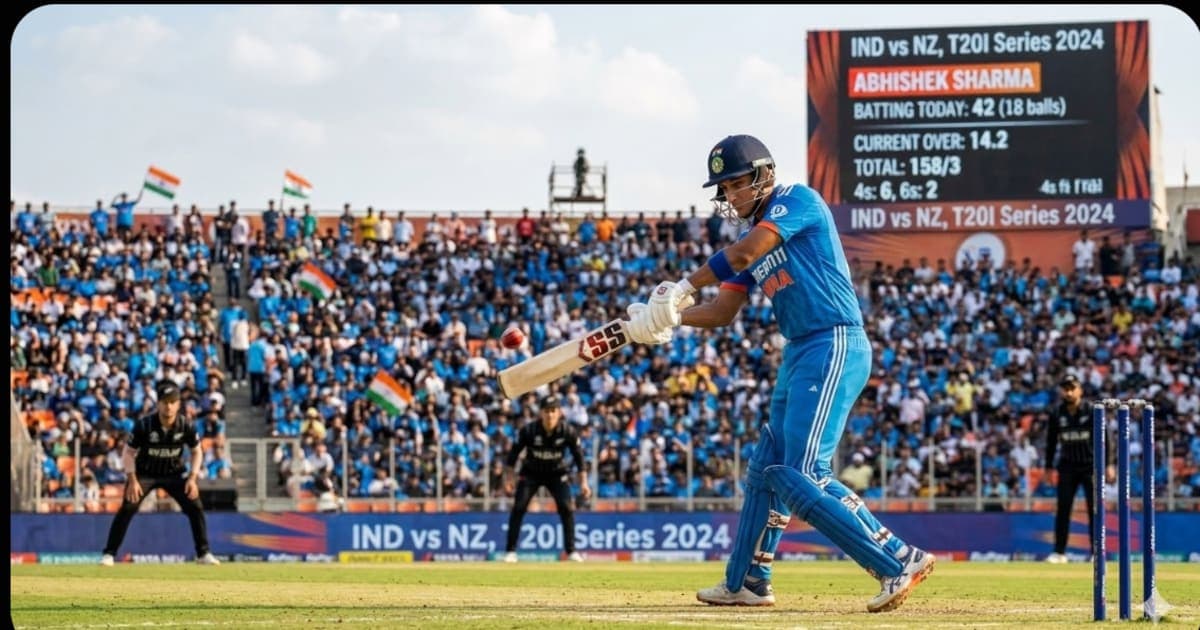
Abhishek Sharma's 52 Off 21 Balls: The Knock That Set the World Cup Final Ablaze
AHMEDABAD, March 8, 2026 — Three dot balls from Matt Henry. Slow start. New Zealand looking sharp, the crowd slightly anxious.
Then Abhishek Sharma happened.
In 21 deliveries that felt more like a highlights reel than a T20 World Cup final innings, the World No. 1 T20 batter announced his long-awaited tournament arrival with 52 runs — 6 fours, 3 sixes — a knock so clean and so brutal that it turned a tense final into a one-sided destruction of the finest bowling attack in the southern hemisphere. [web:209]
The redemption story that Indian cricket had been waiting all tournament for arrived exactly when it was supposed to — under the lights at the world's biggest cricket stadium, in front of 132,000 people who desperately needed him to remember who he was.
The Innings, Ball by Ball
The opening over from Henry was tight — three dots, a boundary, two dot balls, seven runs off it. [web:212] Samson had launched a six off Henry's second delivery to break the early pressure, but Abhishek was quiet. Watching. Assessing.
The second over changed everything.
The moment Abhishek decided he was done being cautious, the Ahmedabad stadium shifted frequency entirely. A flick off his pads to the square leg fence. A drive through the covers. Then a SIX — high, clean, into the second tier — that brought 132,000 people to their feet simultaneously. [web:209]
From that point, it was carnage.
By the end of the fifth over, India were 72 for no loss — a powerplay score that shattered records and obliterated any pretense that this final was going to be a close contest. [web:212] Abhishek's contribution to that 72 was the majority of it, scoring at a rate that no T20 World Cup final had ever seen from an opening batter at this ground.
The numbers that defined his innings:
- 52 runs off just 21 balls
- Strike rate: 247.61
- 6 fours — drives, flicks, cuts, all along the ground with absolute control
- 3 sixes — two over long on, one into the stands at deep midwicket
He was eventually dismissed at the start of the eighth over, caught on the boundary attempting to clear the ropes for a fourth time. India were 110 for 1 at that point, with the platform for something historic firmly set. [web:212]
The Weight Behind Those 21 Balls
To understand why this innings matters, you have to go back to the seven that came before it.
Across the group stage and the semi-final, Abhishek had made 89 runs in seven innings. Three ducks. A nine against England at the Wankhede — a ground where he'd previously smashed 135 off 54 against the same opposition. [web:196] The speculation about dropping him grew louder after every failure, and somehow, the selectors and Suryakumar Yadav held their nerve and kept sending him back. [web:193]
Tonight, he justified every bit of that faith in less time than it takes to have a cup of chai.
The shot that broke the tournament open — that first six off Henry in the second over — was not a desperate heave from a batter in bad form trying to force it. It was the shot of someone who had found their timing, their balance, and their confidence, all at once, in the most important match of the year.
"He's been struggling, but when he gets in, this is what he can do," Sanju Samson told the commentators during a mid-innings break. "We always knew this innings was coming. We just needed to keep trusting him." [web:208]
What His Dismissal Meant for the Innings
When Abhishek was caught at the boundary off Lockie Ferguson — attempting to go over the rope for the fourth time, a decision that, in hindsight, wasn't necessary given how well the innings was already placed — India were 110 for 1 in 8 overs. [web:212]
The platform he'd set with Samson in those first eight overs gave whoever came next the freedom to bat without pressure. Ishan Kishan walked in and immediately found his boundaries. Samson, already into his stride, kept going — bringing up his third consecutive fifty in the tournament and then accelerating past it. [web:209]
By the 12th over, India were 161 for 1. By the 15th over, they had crossed 200. [web:211] The innings that would eventually challenge Pakistan's T20 World Cup record total had been built on the foundation Abhishek laid in those first eight electric overs.
The Final Chapter of a Tournament Story
It is a strange thing, cricket's ability to compress an entire narrative into a single innings. Abhishek Sharma's T20 World Cup 2026 story — weeks of failure, public scrutiny, dropped-or-not speculation, a semi-final non-performance, management faith, and finally the release valve of a final in front of his home crowd — resolved itself in exactly 21 balls tonight.
He finished the innings, walked off to the kind of standing ovation that Narendra Modi Stadium reserves for its best moments, helmet off, bat raised, grinning at the noise — and the noise was enormous.
The chase still has to happen. New Zealand are not a team that folds quietly. But the total India are building, and the manner in which they are building it, has a great deal to do with the 24-year-old from Amritsar who decided, somewhere between the third dot ball and the second over, that he was done being quiet.
Fifty-two runs. Twenty-one balls. Six fours. Three sixes. Tournament redeemed.