The Day AI Threatened India's $250 Billion IT Industry
```markdown # The Perfect Storm: Why Indian IT Stocks Suffered a Historic Crash Today
Date: February 24, 2026 Author: TrnIND
Some days on Dalal Street are bad. Today was something else entirely.
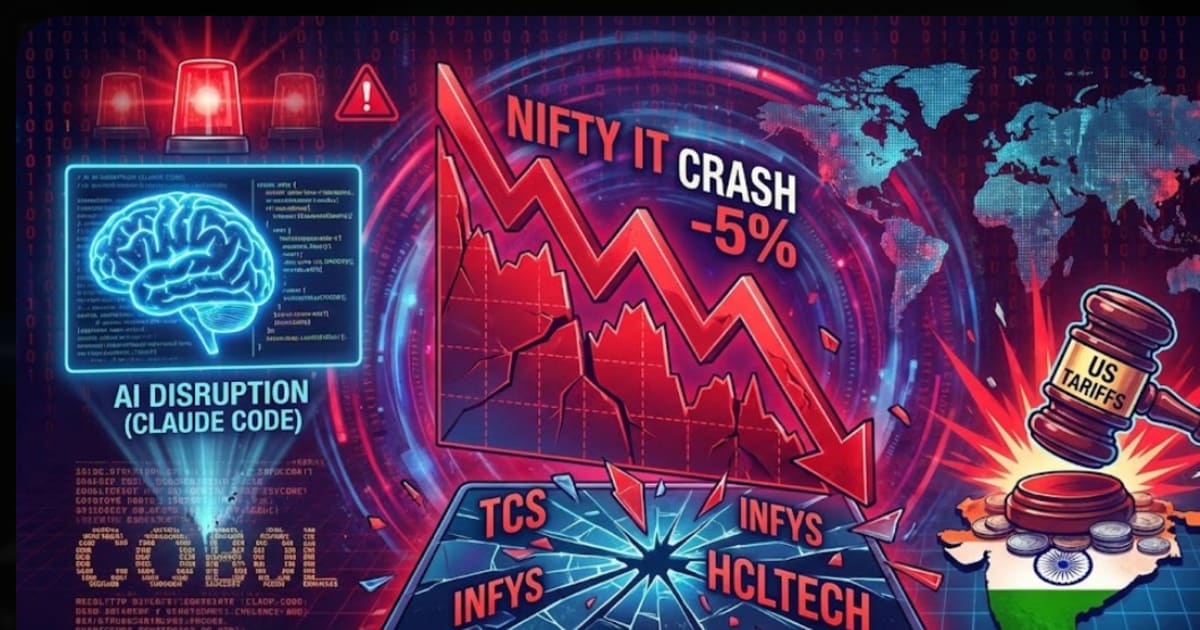
By the time the closing bell rang on February 24, the Nifty IT index had shed 5% — slicing clean through its 200-day moving average like it wasn't even there. TCS, Infosys, HCLTech, Wipro. Every name that retail investors have parked money in for years. All of them battered. Mid-cap tech stocks didn't just fall — some of them went into vertical freefall, dropping 6% to 8.5% before anyone could react.
The broader Nifty 50 broke below 25,500. The damage was real, widespread, and fast.
But here's what made today different from a regular bad market day: this wasn't about overbought charts or a disappointing quarterly result from one company. Something bigger happened. Investors looked at Indian IT and suddenly saw two threats arriving at the same time — one technological, one geopolitical — and decided they didn't want to be holding these stocks while those threats play out.
Let me walk you through exactly what that means.
The Anthropic Announcement That Changed Everything
To understand why the market reacted the way it did, you first need to understand what Indian IT companies actually *do* for a living.
For decades, the backbone of the Indian IT business model has been something called Application Development and Maintenance — ADM, in industry shorthand. At its core, this means deploying large teams of engineers to build, maintain, and patch software systems for Fortune 500 companies in the US and Europe. It's not glamorous work. But it's consistent, predictable, and enormously profitable at scale.
A huge portion of this revenue comes from one sector: Banking, Financial Services, and Insurance (BFSI). Buried deep inside the world's biggest banks are legacy systems written in a programming language called COBOL — code that, in some cases, hasn't been fundamentally restructured since the 1970s. More than 90% of global ATM transactions still run on this infrastructure. Core banking ledgers. Insurance claims processing. It all runs on decades-old COBOL, and nobody has touched the foundations because doing so is extraordinarily expensive, time-consuming, and risky.
So Western banks pay billions every year to Indian IT firms to essentially keep these old systems alive. That's the deal. That's been the deal for thirty years.
Overnight, Anthropic announced a new agentic AI tool called Claude Code — and that deal suddenly looks very different.
This isn't a coding assistant that helps a developer write faster. What Anthropic demonstrated was an AI that can *independently* read, analyze, and refactor massive COBOL codebases into modern languages like Python or Java. Work that would historically require a team of fifty engineers over two years? Claude Code, by Anthropic's own claims, can handle it in weeks, with a fraction of the human oversight.
That is the threat the market priced in today. Not gradually, not over a few weeks of analyst reports and investor calls. All at once, in a single afternoon.
If US banks can point an AI agent at their legacy infrastructure and get it modernized cheaply and quickly, why are they paying Indian IT firms for the same work? The "Time and Material" billing model — where Indian firms charge hourly for human engineers — suddenly looks very exposed. The market didn't wait around for a company earnings call to confirm this. It sold first and will ask questions later.
The Tariff Shock That Arrived at the Worst Possible Time
If the Anthropic announcement was the fire, the weekend's geopolitical news was the fuel poured on top.
Indian IT is deeply dependent on the United States — over 60% of sector export revenue comes from North American clients. That's not a diversification story. That's a concentration risk, and it showed up brutally today.
Here's what happened: the US Supreme Court ruled that Trump's previous tariff measures were unlawful. The President's response was immediate. He invoked Section 122 of the Trade Act of 1974, threatening a 15% universal tariff on imports to address balance-of-payment deficits. Fast, aggressive, and deliberately designed to rattle global markets.
Now, IT services aren't physical goods. They don't cross a border in a shipping container. So Indian IT companies don't face a *direct* tariff hit. But the secondary effects are arguably worse.
When a US corporation wakes up facing a 15% tariff environment and immediate margin pressure, the first thing its CFO does is freeze discretionary spending. Cloud migration projects get paused. Digital transformation initiatives get shelved. New software rollouts get pushed into the next financial year. These are exactly the kinds of projects that fill Indian IT order books — and they're the first things to go when American companies start conserving cash.
Then there's the currency angle. The tariff threat sent the US Dollar surging and put pressure on emerging market currencies. A weaker Rupee sounds good for IT exporters on paper — but when the volatility is this extreme, it becomes nearly impossible for management teams to hedge their exposure and give any kind of reliable forward guidance. Guidance uncertainty makes institutional investors nervous. And nervous institutional investors sell.
Where the Damage Actually Hit
The selling today was indiscriminate in direction but not in magnitude. Bigger companies bled. Mid-caps hemorrhaged.
The mid-cap wreckage was particularly severe. Coforge, Persistent Systems, L&T Technology Services — names that had been trading at rich premium valuations because of their specialized positioning and strong growth rates — got absolutely hammered. Drops of 6% to 8.5% in a single session. The logic was brutal but simple: if the revenue model is under structural threat, premium valuations are the first thing to go. These companies have thinner cushions than the giants, and the market adjusted for that in real time.
The large-caps didn't escape either. Infosys and TCS — the two names every long-term retail investor has in their portfolio somewhere — each fell 3.5% to 4.5%. HCLTech and Tech Mahindra, which carry heavy exposure to telecom and traditional infrastructure management, were hit even harder — down 5% to 7% at points during the session.
The sheer volume of selling in these large-cap counters tells its own story. This wasn't retail panic. Foreign Institutional Investors were pulling capital out of Indian tech and rotating into sectors they feel safer with — capital goods, domestic consumption, FMCG. When FIIs move that decisively, the charts reflect it fast.
Overreaction or a Real Turning Point?
This is the question every investor sitting on IT stocks is wrestling with tonight.
The optimists have a case. AI tools still hallucinate. They make errors. And when those errors involve mission-critical banking infrastructure — systems where a single bug can freeze millions of transactions — human oversight remains non-negotiable for the foreseeable future. There's also the pivot argument: that Indian IT companies, sitting on enormous cash reserves and talent pools, can reposition themselves as "AI orchestrators" — firms that help global clients implement and manage these very tools rather than being replaced by them. The transition would be painful. But these companies have survived disruption before.
The pessimists have an equally valid case. Even in the best-case pivot scenario, margins get squeezed. Clients who used to pay premium rates for routine software maintenance will push hard for price cuts once AI alternatives exist. The argument that Indian IT was already "commoditizing" before today just got a lot louder. And if the business model doesn't collapse, it still gets structurally smaller and less profitable — which is enough to justify a significant de-rating.
Honestly? The market today reflected the fact that nobody has a clear answer yet. And in the absence of clarity, the instinct is to sell.
What This Means if You're Holding IT Stocks
Short term — and I mean the next few weeks — the IT sector is going to behave like a "sell on rise" market. The charts are technically broken. Any minor bounce is likely to attract fresh selling from investors who held through today's carnage and are using the recovery to exit. Until CEOs of these companies get on earnings calls and present *specific, credible plans* for how they monetize AI rather than get replaced by it, the uncertainty premium will stay high.
Trying to catch the bottom here is a high-risk move. The knife is still falling.
For long-term investors holding quality large-caps — TCS, Infosys — the calculus is different. These companies have the balance sheets, the global relationships, and the engineering talent to evolve. A five-to-ten-year horizon changes the picture meaningfully. The question is whether you have the stomach to sit through what might be a prolonged period of underperformance and negative headlines while that evolution happens.
For anyone heavily positioned in mid-cap IT names that were already expensive before today? Capital protection has to come first. This is not the time for averaging down based on a valuation that may have been built on assumptions that no longer hold.
Today was a rough one. And the honest truth is — the full story of what it means for Indian IT is still being written.
**Disclaimer:** This article is for educational and informational purposes only and does not constitute financial, investment, or trading advice. Market analysis and scenarios presented here are based on current available data and are inherently uncertain. Always consult a SEBI-registered financial advisor before making any investment decision. ```