Nobody talks about the real workplace survival toolkit.
Not the productivity apps. Not the standing desk. Not the meditation subscription your company bought for everyone that exactly three people used. The actual toolkit — the thing that gets most of us through a Tuesday — is a group chat, a well-timed meme, and the quiet, collective understanding that everyone around you is also barely holding it together.
Right now, two specific anxieties are dominating the white-collar internet. One is about the future — specifically, whether there's a version of the future where you still have a job. The other is about next Tuesday morning — specifically, the alarm clock, the commute, and the inbox that somehow accumulated 400 new emails over a three-day weekend.
Different fears. Same coping mechanism. Here's what that looks like.
The AI Is Your Friend (According to People
Who Won't Lose Their Jobs to AI)
There is an official narrative about artificial intelligence in the workplace. You've heard it. It comes from LinkedIn thought leaders, keynote speeches at tech conferences, and the occasional company-wide email from a CEO who just got back from Davos.
The narrative goes: AI is a tool, not a threat. A copilot. It handles the drudgery so you can focus on the higher-level creative and strategic work that only humans can do. AI creates jobs. It augments. It empowers. There are millions of new roles we can't even imagine yet, just waiting to be filled by an adaptable, curious workforce that leans into the change.
The internet read all of that.
Then it made memes.
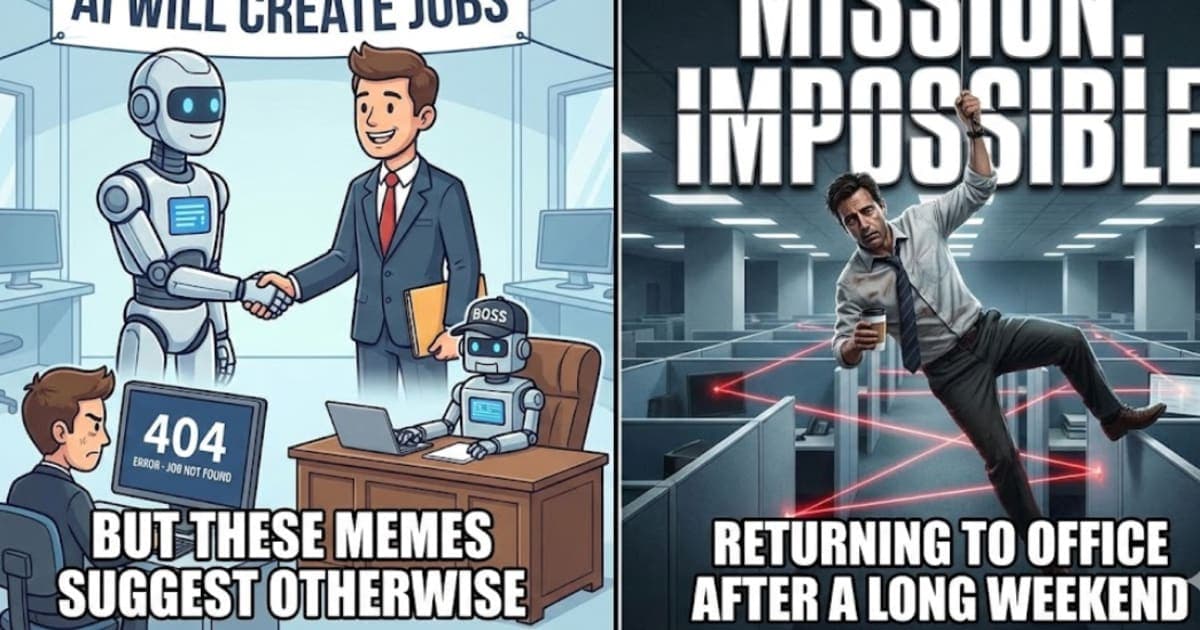
The split-screen format has been everywhere. Left side, labeled "What they said AI would do": a human and a friendly robot shaking hands over a complex architectural blueprint. Right side, labeled "What AI is actually doing": a human staring at a screen that says "Your position has been automated" while a cartoon robot in a party hat dances on a pile of money.
The developer version hits differently. A person sweating through their shirt, realizing the AI tool they just opened produced cleaner, better, more functional code in four seconds than they managed in four hours. Caption: "Me trying to explain to my boss why I'm still necessary after GPT-4 just did my entire week's work before lunch."
What makes these land so hard is that they aren't really jokes about AI. They're jokes about the gap — the specific, uncomfortable gap between what we're being told is happening and what it feels like is happening. The "higher-level creative tasks" we're supposed to pivot to sound great in a boardroom presentation. They sound slightly less great at 11 PM when you're Googling whether your specific job title has already been automated and the search results are not reassuring.
The humor is real. So is the anxiety underneath it. That's usually how the best memes work.
Mission: Survive the Tuesday Morning
If the AI memes are about the slow, creeping dread of the future, the return-to-office memes are about something much more immediate and much more personal.
The alarm clock. 6 AM. The day after a long weekend.
There is a specific quality to that particular alarm that is unlike any other alarm. You had three days. Three full days of sleeping in, wearing soft clothes, eating when you felt like it, and existing as a human person with autonomy over your time. And now your phone is screaming at you and somewhere across the city, a fluorescent-lit conference room is waiting.
The internet has collectively decided that returning to work after a long weekend is no longer just an inconvenience. It is a covert operation. A black op. The Mission: Impossible theme music is practically audible.
"Me attempting to extract myself from the comforter at 6:00 AM. Protocol: Survive."
The commute gets the action-sequence treatment. Someone sprinting through a train station, weaving around slow walkers like they're navigating laser tripwires, text overlay reading: "Rendezvous point: 9 AM all-hands meeting. Status: Compromised. Caffeine levels: Critical."
The absurdity is the point. Because the feeling it's describing — the feeling that simply getting dressed and commuting and being present in a room requires a genuinely heroic level of effort — is completely real. The hyperbole isn't that far off. Putting on "hard pants" after three days in joggers does require a specific kind of psychological mobilization. The meme just says that out loud.
And then there's the office itself.
Once you're in, the mission shifts from "get there" to "survive the day with your soul approximately intact." The specific threat level: the colleague who wants to debrief their entire weekend to you in the corridor, in detail, before you've had coffee.
Memes show people pressing flat against walls to avoid detection. Army-crawling under desks. Taking elaborate alternate routes to the kitchen to avoid a fifteen-minute conversation about someone's cousin's engagement that you have been cornered into twice before. The objective is simple: make it to 5 PM. That's it. That's the whole mission.
Why We Keep Coming Back to This
Both of these meme trends are, at their core, about the same thing.
A working world that keeps asking more — more output, more adaptability, more enthusiasm for the changes that are happening to you rather than for you — and a collective of ordinary people who are tired, slightly scared, and have realized that laughing about it together is about the most honest response available.
The AI memes don't solve the job insecurity. The Mission: Impossible commute memes don't make the alarm clock easier. But they do something that matters: they confirm, publicly, that you're not the only one who finds this hard. That the exhaustion is real. That the anxiety about the future is shared. That the specific agony of a Tuesday morning after a long weekend is a universal human experience and not a personal weakness.
The group chat is the water cooler now. And the memes are the conversation we're all having about the thing nobody wants to say directly.
This article is a cultural commentary piece on contemporary workplace meme culture. All meme formats described are illustrative of publicly circulating social media trends.