Every February, the same thing happens.
A large portion of India — chartered accountants, news anchors, retired uncles with strong opinions about fiscal deficits — sits down to seriously engage with the Union Budget. They have notepads. Some of them have spreadsheets. They are ready.
The rest of India — which is most of us — opens Twitter, watches the first ten minutes of the speech, and immediately starts looking for the memes.
Budget 2026 was Nirmala Sitharaman's ninth consecutive budget. Record-setting, historically significant, full of infrastructure pushes and biopharma hubs and capital expenditure targets that genuinely matter. The economists had a lot to say about all of it.
The internet, meanwhile, was having a completely different kind of day. Here's what that looked like.
"Meri Taraf Mat Dekhiye" — The Middle Class and
Its Annual Heartbreak
There's a ritual the salaried Indian goes through every budget season that is, at this point, practically a religious observance.
You wake up with hope. Not blind hope — measured, reasonable, specifically calibrated hope. Maybe this year the standard deduction goes up. Maybe the 80C limit finally gets revised. Maybe the income tax slab gets a gentle, compassionate nudge in the right direction. You've been patient. You've been paying. Surely this year is the year.
Then the speech starts. You listen. You keep listening. The FM mentions infrastructure. She mentions biopharma. She mentions green energy corridors. All very good. Very necessary. But the thing you're actually waiting for — the small, personal, please just let me breathe a little thing — keeps not coming.
And then somebody posts it.
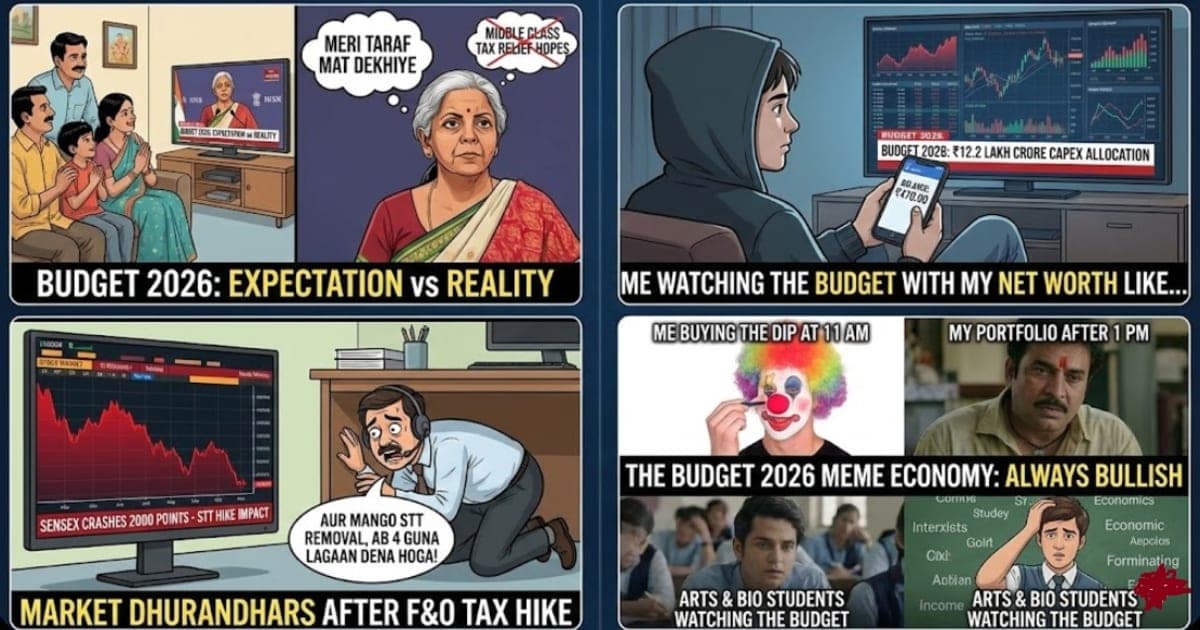
Nirmala Sitharaman, expression completely unreadable, looking directly ahead. Caption: "Meri taraf mat dekhiye, main aapki koi sahayata nahi kar paungi." (Don't look at me. I won't be able to help you.)
That one broke the internet inside about forty-five minutes.
The template spread everywhere simultaneously. Middle class asking for an 80C limit increase — FM looking stoically ahead. Salaried employee asking about standard deduction — FM looking stoically ahead. Someone asking literally anything about personal tax relief — FM looking stoically ahead. The Panchayat dialogue got pulled in too — "Aapke fund se thoda paisa mil jaata toh..." delivered as the voice of the common taxpayer, always just barely missing what they needed.
The volume of these memes said something real, underneath all the humor. The middle class didn't get a tax break. But the sense of humor? Completely intact. Over-indexed, even, as a compensatory mechanism.
₹470 in My Bank Account — Gen Z
Discovers Macroeconomics
While the salaried uncles were processing their annual tax disappointment, a different demographic was having a completely different crisis.
See, Gen Z and late millennials tuned into Budget 2026 out of a very specific kind of FOMO — the feeling that something important was happening and you were supposed to have opinions about it. So they watched. They saw terms like "fiscal consolidation" and "capex allocation of ₹12.2 lakh crore" and "enhanced manufacturing PLI schemes."
And then they looked at their bank balance.
₹470.
The meme practically wrote itself. "Me watching the Finance Minister allocate ₹12.2 lakh crore for capital expenditure while I have ₹470 in my savings account and am deciding whether I can justify the Swiggy delivery fee."
Mr. Bean sitting in a waiting room — "Me waiting to see if the budget will just directly deposit ₹10,000 into my account." Spoiler: it did not.
The arts and humanities students staring blankly while their B.Com friends tried urgently to explain what a fiscal deficit was in real-time also had a very strong showing.
The reason this meme hit so hard is the same reason most good memes hit hard — it's just true. There is something genuinely funny about the gap between the scale of what's being discussed (trillions of rupees, GDP projections, infrastructure corridors spanning multiple states) and the lived financial reality of a large chunk of the people watching (figuring out whether to order from Blinkit or walk to the grocery store). The ₹470 meme didn't mock the budget. It just held a mirror up to the disconnect, and the disconnect was hilarious.
The Sensex Fell 2000 Points and "Dhurandhar"
Had a Moment
The salaried class was hurt. The broke Gen Z was confused but amused. And then there was the third group — the retail investors — who were just straight-up bleeding.
The trigger: a Securities Transaction Tax (STT) hike on Futures & Options trading, going from 0.02% to 0.05% on futures. In isolation, that sounds technical and boring. In practice, the market treated it like a declaration of war. The Sensex dropped over 2,000 points. Screens went red. Portfolios that had looked healthy at 9:30 AM looked completely different by 1 PM. Over ₹10 lakh crore in investor wealth, gone.
The meme response was immediate and specific.
Lagaan got its annual revival. Falling stock charts captioned: "Aur mango STT removal, ab 4 guna lagaan dena hoga!" — the tax-burden metaphor practically writes itself when a hike shows up in a budget speech.
But the real takeover belonged to Dhurandhar. Dramatic betrayal sequences from the film cut against Nifty50 graphs in freefall. The self-proclaimed market experts — the YouTube traders who post videos about their "setups" and their "risk-reward ratios" from ring-lit home studios — were suddenly depicted hiding under their desks, furiously Googling "how to open a Fixed Deposit" and "is FD better than F&O." The Dhurandhar-to-FD pipeline meme was savage and extremely accurate.
And then, of course, the clown makeup. The eternal clown makeup. Representing the traders who saw the first 500-point drop at 10 AM, confidently said "buy the dip" on their group chats, watched it fall another 800 points, said "this is the real dip, buying more," and then went quiet around 1 PM when the Sensex was sitting 2,000 points below open.
We've all been that clown. That's why the meme works.
The Only Thing That Never Crashes
Budget 2026 was, in many ways, a painful day for a lot of people holding a lot of different kinds of financial hope. The middle class didn't get its tax break. The broke Gen Z confirmed that macroeconomics operates at a scale that does not personally include them. The F&O traders had a day that none of them will be describing fondly at dinner parties.
But the meme economy? Absolute bull run. No correction. No volatility. Just compounding returns all day.
There's something genuinely Indian about this — the speed with which collective financial pain gets converted into collective humor. It's not denial exactly. The people making the ₹470 memes know their bank balance is ₹470. The traders posting the clown makeup know exactly how much they lost. The humor isn't an escape from the reality. It's just the most honest way of saying — yes, this is bad, and we're all in it together, and the only reasonable response is to laugh.
That's not a coping mechanism. That's just how this country works.
This article is a cultural commentary piece based on publicly circulated social media trends during Budget 2026 season. All meme references are illustrative of broader internet culture and do not constitute financial advice.