Imagine sitting in a cinema hall and watching Rajesh Khanna walk onto screen in a film released this year.
Not archival footage. Not a tribute montage. A new performance — his face, his voice, his specific way of tilting his head before delivering a line. The mannerisms are right. The cadence is right. For a few minutes, everything your memory holds about that person feels suddenly, disconcertingly present.
This is happening. Not as a concept, not as a Hollywood experiment you read about in a foreign publication — in Mumbai, now, in production pipelines that are already running.
The question of whether it should is one the industry has mostly avoided answering directly. That avoidance is becoming harder to sustain.
How It Actually Works
The term "digital resurrection" sounds cleaner than the process is.
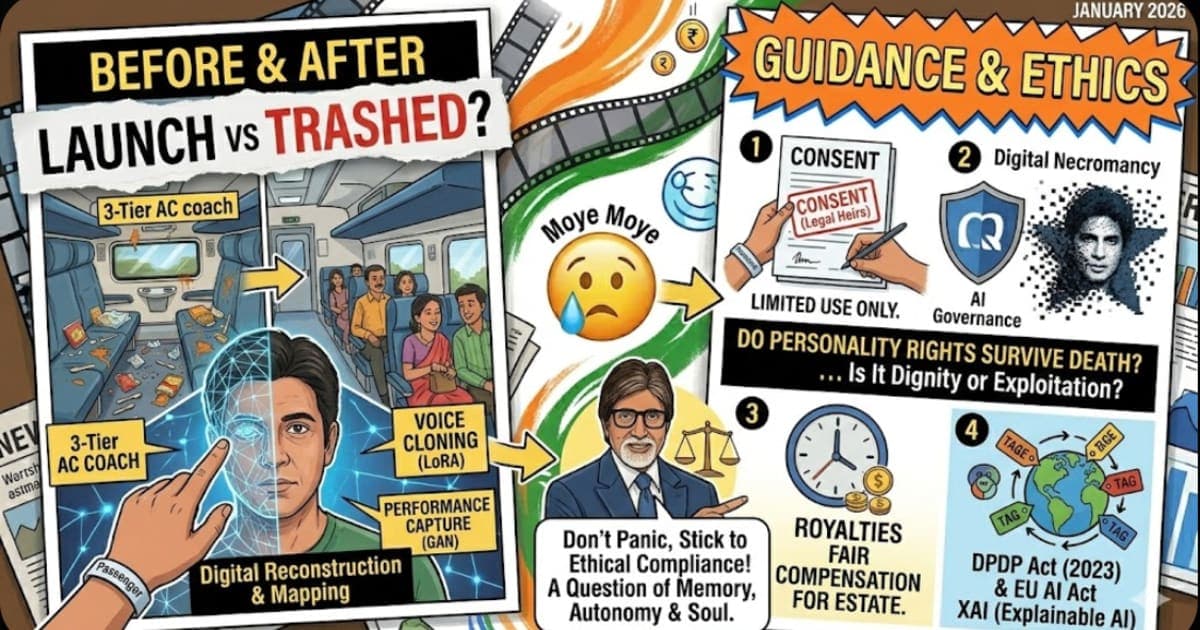
It starts with voice. Hundreds of hours of archival audio — film dialogue, interviews, public appearances, anything where the voice was recorded clearly enough to be useful. An AI model trains on this material until it can synthesize new speech in that exact timbre and cadence. Not an impression. Not a sound-alike. The actual voice, saying words it never said, in a recording that never happened.
Then the face. A living actor performs the scene. In post-production, a GAN — a Generative Adversarial Network — trained on every frame of film featuring the deceased star maps their face onto the body of the performer. Every blink. Every micro-expression. The slight asymmetry that made the face recognisable in the first place.
More advanced systems go further — analysing how a person walked, how they gestured, the specific rhythm of how they moved through space. A kinetic signature, as precise as a fingerprint.
The technology works. That's not the debate anymore. The debate is what to do with something that works this well.
The Argument For It
The people making the case for digital resurrection are not all cynics looking to monetise a dead star's name. Some of them have arguments worth taking seriously.
The most sympathetic case is unfinished work. When a film halts mid-production because an actor dies — and it has happened, more than once, in Hindi cinema — the crew loses their livelihood, the project dies, and the star's final work remains permanently incomplete. The argument that AI completion honours their last creative act rather than abandoning it is not a trivial one.
There's also the preservation argument. For future generations who will never know what it felt like to watch Dilip Kumar in a cinema hall the year a film released, an interactive archive built on this technology is something different from a static clip on YouTube. Different in ways that might matter.
And there are the creative possibilities that are genuinely exciting if you can set aside the ethical weight for a moment — what it would mean to have the films that time made impossible. The collaborations that never happened. The "what ifs" that every generation of film lovers has always carried quietly.
The Argument Against —
And It's the Stronger One
The problem is consent. It's always consent.
A deceased artist cannot tell you whether they want to appear in this project, with this script, for this director, delivering this dialogue. They cannot tell you they'd rather not endorse this product, appear in this political context, or have their likeness used in a scene they would have refused at any point in their living career.
They cannot tell you anything. That's the whole problem.
An artist who spent decades carefully choosing roles, declining certain projects, building a specific kind of legacy — that curation is part of their art. Digital resurrection removes it entirely. Their image becomes available for any use that their estate agrees to, which is a very different thing from any use they would have agreed to.
The "zombie" problem, as some ethicists have started calling it, is this: we are creating a version of a person that performs on demand indefinitely, without the person's participation, without their judgment, without the thing that made them worth watching in the first place.
The Legal Situation Is a Mess
Indian law was not written for a world where a person's face can be perfectly replicated after their death, and it shows.
Personality rights exist in India — they protect living people from having their name, image, or likeness used commercially without permission. The question of whether those rights survive death is genuinely unsettled.
One argument: likeness is property, it passes to legal heirs, they can license it the way they license any other inherited asset.
The counter-argument: personality is an extension of the right to life itself, and ends when life ends. Under this reading, nobody owns a dead person's face — which creates its own problems.
India's Digital Personal Data Protection Act is evolving. It hasn't caught up to what the technology is already doing. That gap is currently the only real barrier to mass deployment — not ethics, not industry self-regulation, just legal uncertainty about who can be sued and for what.
When that uncertainty resolves, the floodgates open. Which is why the framework needs to exist before that happens, not after.
What a Responsible Framework
Would Actually Look Like
The technology isn't going away. Calling for a ban is not a realistic position. What is realistic is demanding specific rules that distinguish honourable use from exploitation.
Consent through the estate — but specific, not blanket. The decision should rest with immediate family or legal heirs. But a blanket agreement to use the likeness for any purpose is not consent — it's a commercial license dressed as one. Heirs should have veto power over the specific script, specific context, specific use.
Transparency, always. Every scene featuring a digitally resurrected performer needs a visible disclaimer. Audiences have the right to know what they're watching. This should not be negotiable.
Hard limits on use. Political propaganda. Sexually explicit content. Product endorsements the artist demonstrably opposed during their lifetime. These should be absolute prohibitions — not guidelines, not best practices, legal red lines.
Fair compensation for estates. If a studio profits from a digital performance, the estate receives royalties. The structure already exists for music and film rights. Apply it here.
The Thing the Technology
Cannot Actually Do
Even if every ethical condition is met — consent from the estate, proper compensation, transparent disclosure — there is something the most sophisticated model in the world cannot replicate.
The reason people mourned these artists is not because the face was lost or the voice recording became unavailable. It's because something unrepeatable ended.
The spontaneity of a performance that didn't know it was going to be great. The specific quality of presence that can't be decomposed into training data and reconstructed. The thing that made a particular scene land in a way that nobody — including the actor — could have fully explained.
Digital resurrection produces a perfect simulation. Technically perfect, perhaps. But the reason we valued the original was precisely that it wasn't produced — it happened. Once, in a specific moment, in a way that couldn't be replicated even then.
The technology gives us the face and the voice. It cannot give us back what we actually lost.
Where This Leaves Us
The question isn't really whether AI can bring dead Bollywood stars back to the screen. It clearly can.
The question is what we're actually doing when we do it — whether we're honouring the memory of someone or refusing to accept it, whether we're preserving an artist's legacy or converting it into an asset that generates quarterly returns.
Those are different things. The technology doesn't make that distinction for us. The law, currently, doesn't either. Which means the industry and the audience have to.
And "the audience will pay for it" is not, by itself, a sufficient answer.
No specific ongoing production has been identified or named in this article. AI resurrection technology and its application in Indian cinema is an active and evolving area. Legal frameworks referenced are current as of February 2026 and subject to change.